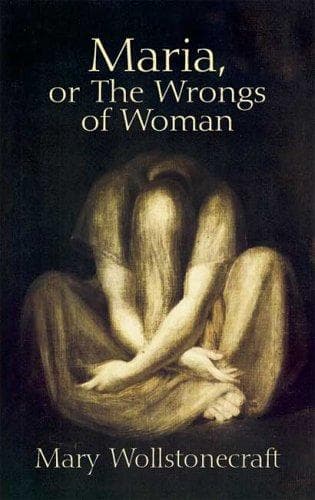
Maria; Or, The Wrongs of WomanWollstonecraft, Mary
General
Maria; Or, The Wrongs of Woman
Wollstonecraft, Mary
Autobiographical fiction; Feminist fiction; Women -- Fiction
“A gentleman of large fortune and of polished manners, had lately
visited very frequently at our house, and treated me, if possible, with
more respect than Mr. Venables paid him; my pregnancy was not yet
visible, his society was a great relief to me, as I had for some time
past, to avoid expence, confined myself very much at home. I ever
disdained unnecessary, perhaps even prudent concealments; and my
husband, with great ease, discovered the amount of my uncle’s parting
present. A copy of a writ was the stale pretext to extort it from me;
and I had soon reason to believe that it was fabricated for the
purpose. I acknowledge my folly in thus suffering myself to be
continually imposed on. I had adhered to my resolution not to apply to
my uncle, on the part of my husband, any more; yet, when I had received
a sum sufficient to supply my own wants, and to enable me to pursue a
plan I had in view, to settle my younger brother in a respectable
employment, I allowed myself to be duped by Mr. Venables’ shallow
pretences, and hypocritical professions.
“Thus did he pillage me and my family, thus frustrate all my plans of
usefulness. Yet this was the man I was bound to respect and esteem: as
if respect and esteem depended on an arbitrary will of our own! But a
wife being as much a man’s property as his horse, or his ass, she has
nothing she can call her own. He may use any means to get at what the
law considers as his, the moment his wife is in possession of it, even
to the forcing of a lock, as Mr. Venables did, to search for notes in
my writing-desk—and all this is done with a show of equity, because,
forsooth, he is responsible for her maintenance.
“The tender mother cannot _lawfully_ snatch from the gripe of the
gambling spendthrift, or beastly drunkard, unmindful of his offspring,
the fortune which falls to her by chance; or (so flagrant is the
injustice) what she earns by her own exertions. No; he can rob her with
impunity, even to waste publicly on a courtezan; and the laws of her
country—if women have a country—afford her no protection or redress
from the oppressor, unless she have the plea of bodily fear; yet how
many ways are there of goading the soul almost to madness, equally
unmanly, though not so mean? When such laws were framed, should not
impartial lawgivers have first decreed, in the style of a great
assembly, who recognized the existence of an _être suprême_, to fix the
national belief, that the husband should always be wiser and more
virtuous than his wife, in order to entitle him, with a show of
justice, to keep this idiot, or perpetual minor, for ever in bondage.
But I must have done—on this subject, my indignation continually runs
away with me.
Public-domain text, read in full here on John Shaqi.
Reviews
Reviews
No reviews yet
Be the first to share your thoughts on this work.
Elsewhere in the archive
Join the Discussion
Join the discussion
Sign in to leave a comment or review.
Sign InorCreate an account