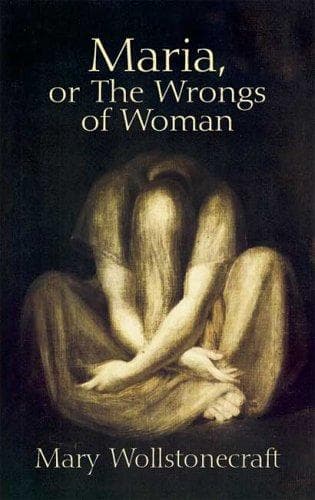
Maria; Or, The Wrongs of WomanWollstonecraft, Mary
General
Maria; Or, The Wrongs of Woman
Wollstonecraft, Mary
Autobiographical fiction; Feminist fiction; Women -- Fiction
To part with Darnford was indeed cruel.—It was to feel most painfully
alone; but she rejoiced to think, that she should spare him the care
and perplexity of the suit, and meet him again, all his own. Marriage,
as at present constituted, she considered as leading to immorality—yet,
as the odium of society impedes usefulness, she wished to avow her
affection to Darnford, by becoming his wife according to established
rules; not to be confounded with women who act from very different
motives, though her conduct would be just the same without the ceremony
as with it, and her expectations from him not less firm. The being
summoned to defend herself from a charge which she was determined to
plead guilty to, was still galling, as it roused bitter reflections on
the situation of women in society.
CHAPTER 17
Such was her state of mind when the dogs of law were let loose on her.
Maria took the task of conducting Darnford’s defence upon herself. She
instructed his counsel to plead guilty to the charge of adultery; but
to deny that of seduction.
The counsel for the plaintiff opened the cause, by observing, “that his
client had ever been an indulgent husband, and had borne with several
defects of temper, while he had nothing criminal to lay to the charge
of his wife. But that she left his house without assigning any cause.
He could not assert that she was then acquainted with the defendant;
yet, when he was once endeavouring to bring her back to her home, this
man put the peace-officers to flight, and took her he knew not whither.
After the birth of her child, her conduct was so strange, and a
melancholy malady having afflicted one of the family, which delicacy
forbade the dwelling on, it was necessary to confine her. By some means
the defendant enabled her to make her escape, and they had lived
together, in despite of all sense of order and decorum. The adultery
was allowed, it was not necessary to bring any witnesses to prove it;
but the seduction, though highly probable from the circumstances which
he had the honour to state, could not be so clearly proved.—It was of
the most atrocious kind, as decency was set at defiance, and respect
for reputation, which shows internal compunction, utterly disregarded.”
A strong sense of injustice had silenced every motion, which a mixture
of true and false delicacy might otherwise have excited in Maria’s
bosom. She only felt in earnest to insist on the privilege of her
nature. The sarcasms of society, and the condemnations of a mistaken
world, were nothing to her, compared with acting contrary to those
feelings which were the foundation of her principles. [She therefore
eagerly put herself forward, instead of desiring to be absent, on this
memorable occasion.]
Convinced that the subterfuges of the law were disgraceful, she wrote a
paper, which she expressly desired might be read in court:
Public-domain text, read in full here on John Shaqi.
Reviews
Reviews
No reviews yet
Be the first to share your thoughts on this work.
Elsewhere in the archive
Join the Discussion
Join the discussion
Sign in to leave a comment or review.
Sign InorCreate an account