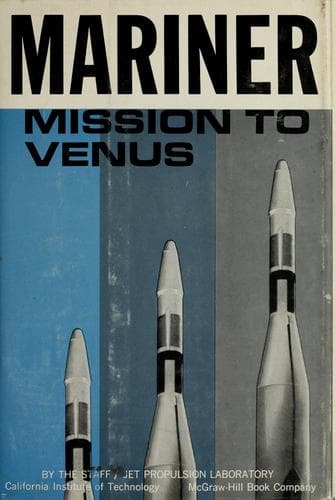
Mariner Mission to VenusJet Propulsion Laboratory (U.S.)
Science
Mariner Mission to Venus
Jet Propulsion Laboratory (U.S.)
Project Mariner (U.S.)
[Illustration: _Mariner spacecraft with solar panels in open
position. Note extension to left panel to balance solar pressures in
flight._]
The Mariner battery used sealed silver-zinc cells and had a capacity of
1000 watt-hours. It weighed 33 pounds and was recharged in flight by the
solar panels.
The solar panels, as originally designed, were 60 inches long by 30
inches wide and contained approximately 9800 solar cells in a total area
of 27 square feet. Each solar cell produced only about 230
one-thousandths of a volt. The entire array was designed to convert the
Sun’s energy to electrical power in the range between 148 and 222 watts.
When a later design change required the extension of one panel in order
to add more solar cells, it was necessary to add a blank extension to
the other panel in order to balance the solar pressure on the
spacecraft.
In order to protect the solar cells from the infrared and ultraviolet
radiation of the Sun, which would produce heat but no electrical energy,
each cell was shielded from these rays by a glass filter which was
nevertheless transparent to the light which the cells converted into
power.
The power subsystem electronics circuits were housed in another of the
hexagon chassis cases. This equipment was designed to receive and switch
power either from the solar panels, the battery, or a combination of the
two, to a booster-regulator.
CC&S: THE BRAIN AND THE STOPWATCH
Once the Atlas booster lifted Mariner off the launch pad, the digital
Central Computer and Sequencer (CC&S) performed certain computations and
provided the basic timing control for those spacecraft subsystems which
required a sequenced programming control.
The CC&S was designed to initiate the operations of the spacecraft in
three distinct sequences or “modes”: (1) the launch mode, from launch
through the cruise configuration; (2) the midcourse propulsion mode,
when Mariner readjusted its sights on Venus; and (3) the encounter mode,
involving commands for data collection in the immediate vicinity of the
planet.
The CC&S timed Mariner’s actions as it travelled more than 180 million
miles in pursuit of Venus. A highly accurate electronic clock
(crystal-controlled oscillator) scheduled the operations of the
spacecraft subsystems. The oscillator frequency of 307.2 kilocycles was
reduced to the 2,400- and 400-cycle-per-second output required for the
power subsystem.
The control oscillator also timed the issuance of commands by the CC&S
in each of the three operating modes of the spacecraft.
A 1-pulse-per-minute signal was provided for such launch sequence events
as the extension of the solar panels 44 minutes after launch, turning on
power for the attitude control subsystem one hour after launch, and for
certain velocity correction commands during the midcourse maneuver.
Public-domain text, read in full here on John Shaqi.
Reviews
Reviews
No reviews yet
Be the first to share your thoughts on this work.
Join the Discussion
Join the discussion
Sign in to leave a comment or review.
Sign InorCreate an account