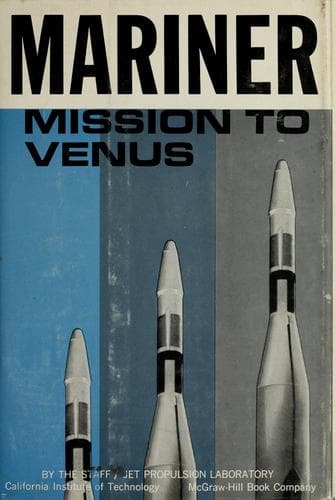
Mariner Mission to VenusJet Propulsion Laboratory (U.S.)
Science
Mariner Mission to Venus
Jet Propulsion Laboratory (U.S.)
Project Mariner (U.S.)
On September 8, at 12:50 p.m., EST, the spacecraft lost its attitude
control, which caused the power serving the scientific instruments to
switch off and the gyroscopes to switch on automatically for
approximately three minutes, after which normal operation was resumed.
The cause was not apparent but the chances of a strike by some small
space object seemed good.
As a result of this event, a significant difference in the apparent
brightness reading of the Earth sensor was noted. This sensor had been
causing concern for some time because its readings had decreased to
almost zero. Further decrease, if actually caused by the instrument and
not by the telemetry sensing elements, could result in loss of Earth
lock and the failure of radio contact.
After the incident of September 8, the Earth sensor brightness reading
increased from 6 to 63, a normal indication for that day. Thereafter,
this measurement decreased in an expected manner as the spacecraft
increased its distance from the Earth.
Mariner II was now embarked on the long cruise. On September 12, the
distance from the Earth was 2,678,960 miles and the spacecraft speed
relative to the Earth was 6,497 miles per hour. Mariner was accelerating
its speed as the Sun’s gravity began to exert a stronger pull than the
Earth’s. On October 3, Mariner was nearly 6 million miles out and moving
at 6,823 miles per hour relative to the Earth. A total of 55,600,000
miles had been covered to that point.
Considerable anxiety had developed at JPL when Mariner’s Earth sensor
reading had fallen off so markedly. This situation was relieved by the
unexplained return to normal on September 8, although the day-to-day
change in the brightness number was watched closely. The apparent
ability of the spacecraft to recover its former performance after the
loss of attitude control on September 8 and again on September 29 was an
encouraging sign.
Another disturbing event occurred on October 31, when the output from
one solar panel deteriorated abruptly. The entire power load was thrown
on the other panel, which was then dangerously near its maximum rated
output. To alleviate this situation, the cruise scientific instruments
were turned off. A week later, the malfunctioning panel returned to
normal operation and the science instruments were again turned on.
Although the trouble had cleared temporarily, it developed again on
November 15 and never again corrected itself. The diagnosis was a
partial short circuit between one string of solar cells and the panel
frame, but by now the spacecraft was close enough to the Sun so that one
panel supplied enough power.
By October 24, the spacecraft was 10,030,000 miles from the Earth and
was moving at 10,547 miles per hour relative to the Earth. The distance
from Venus was now 21,266,000 miles.
Public-domain text, read in full here on John Shaqi.
Reviews
Reviews
No reviews yet
Be the first to share your thoughts on this work.
Join the Discussion
Join the discussion
Sign in to leave a comment or review.
Sign InorCreate an account