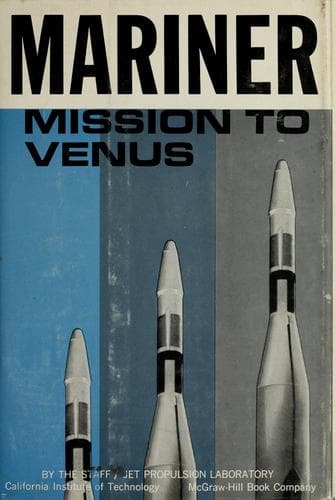
Mariner Mission to VenusJet Propulsion Laboratory (U.S.)
Science
Mariner Mission to Venus
Jet Propulsion Laboratory (U.S.)
Project Mariner (U.S.)
Data were still being received during these final days and the Earth and
Sun lock were still being maintained. Although the antenna hinge angle
was no longer being automatically readjusted by the spacecraft, commands
were sent from the Earth in an attempt to keep the antenna pointed at
the Earth, even if the Earth sensor were no longer operating properly.
At 2 a.m., EST, January 3, 1963, 20 days after passing Venus, Mariner
finished transmitting 30 minutes of telemetry data to Johannesburg and
the station shut down its operation. When Woomera’s DSIF 4 later made a
normal search for the spacecraft signal, it could not be found.
Goldstone also searched in vain for the spacecraft transmissions, but
apparently Mariner’s voice had at last died, although the spacecraft
would go into an eternal orbit around the Sun.
It was estimated that Mariner’s aphelion (farthest point out) in its
orbit around the Sun would occur on June 18, 1963, at a distance of
113,813,087 miles. Maximum distance from the Earth would be 98,063,599
miles on March 30, 1963; closest approach to the Earth: 25,765,717 miles
on September 27, 1963.
THE RECORD OF MARINER
The performance record of Mariner II exceeded that of any spacecraft
previously launched from Earth:
—It performed the first and most distant trajectory-correcting maneuver
in deep space, firing a rocket motor at the greatest distance from the
Earth: 1,492,000 miles (September 4, 1962).
—The spacecraft transmitted continuously for four months, sending back
to the Earth some 90 million bits of information while using only 3
watts of transmitted power.
—Useful telemetry measurements were made at another record distance from
the Earth: 53.9 million miles (January 3, 1963).
—Mariner II was the first spacecraft to operate in the immediate
vicinity of another planet and return useful scientific information to
the Earth: approximately 21,598 miles from Venus (December 14, 1962).
—Measurements were made closest to the Sun: 65.3 million miles away
(December 27, 1962).
—Mariner’s communication system operated for the longest continuous
period in interplanetary space: 129 days (August 27, 1962, to January
3, 1963).
—Mariner achieved the longest continuous operation of a spacecraft
attitude-stabilization system in space, and at a greater distance from
the Earth than any previous spacecraft: 129 days (August 27, 1962, to
January 3, 1963), at 53.9 million miles from the Earth.
CHAPTER 6
THE TRACKING NETWORK
Thirty-six million miles separated the Earth from Venus at encounter.
Communicating with Mariner II and tracking it out to this distance, and
beyond, represented a tremendous extension of man’s ability to probe
interplanetary space.
The problem involved:
Public-domain text, read in full here on John Shaqi.
Reviews
Reviews
No reviews yet
Be the first to share your thoughts on this work.
Join the Discussion
Join the discussion
Sign in to leave a comment or review.
Sign InorCreate an account