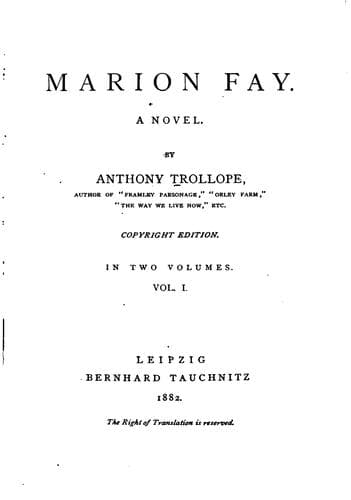
England -- Fiction; Love stories; Male friendship -- Fiction; Quakers -- Fiction; Social classes -- Fiction
"If you loved me, my lord, you would not torture me." She had seated
herself now on the sofa, turning her face away from him over her
shoulder so that she might in some degree hide her tears. He sat
himself at her side, and for a moment or two got possession of her
hand.
"Marion," he said, pleading his case with all the strength of words
which was at his command, "you know, do you not, that no moment of
life can be of more importance to me than this?"
"Is it so, my lord?"
"None can be so important. I am striving to get her for my companion
in life, who to me is the sweetest of all human beings. To touch
you as I do now is a joy to me, even though you have made my heart
so sad." At the moment she struggled to get her hand away from
him, but the struggle was not at first successful. "You answer me
with arguments which are to me of no avail at all. They are, to my
thinking, simply a repetition of prejudices to which I have been all
my life opposed. You will not be angry because I say so?"
"Oh, no, my lord," she said; "not angry. I am not angry, but indeed
you must not hold me." With that she extricated her hand, which he
allowed to pass from his grasp as he continued his address to her.
"As to all that, I have my opinion and you have yours. Can it be
right that you should hold to your own and sacrifice me who have
thought so much of what it is I want myself,--if in truth you love
me? Let your opinion stand against mine, and neutralize it. Let mine
stand against yours, and in that we shall be equal. Then after that
let love be lord of all. If you love me, Marion, I think that I have
a right to demand that you shall be my wife."
There was something in this which she did not know how to
answer;--but she did know, she was quite sure, that no word of his,
no tenderness either on his part or on her own, would induce her to
yield an inch. It was her duty to sacrifice herself for him,--for
reasons which were quite apparent to herself,--and she would do it.
The fortress of her inner purpose was safe, although he had succeeded
in breaking down the bulwark by which it had been her purpose to
guard it. He had claimed her love, and she had not been strong enough
to deny the claim. Let the bulwark go. She was bad at lying. Let her
lie as she might, he had wit enough to see through it. She would not
take the trouble to deny her love should he persist in saying that
it had been accorded to him. But surely she might succeed at last in
making him understand that, whether she loved him or no, she would
not marry him. "I certainly shall never be your wife," she said.
"And that is all?"
"What more, my lord?"
"You can let me go, and never wish me to return?"
Public-domain text, read in full here on John Shaqi.
Reviews
Reviews
No reviews yet
Be the first to share your thoughts on this work.
Elsewhere in the archive
Join the Discussion
Join the discussion
Sign in to leave a comment or review.
Sign InorCreate an account