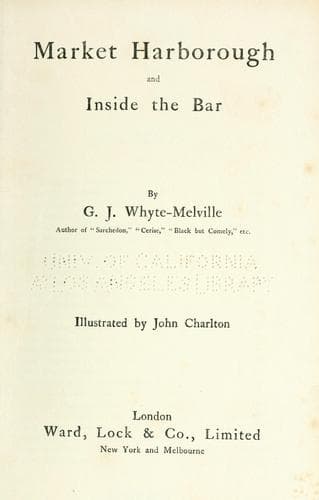
Market Harborough, and Inside the BarWhyte-Melville, G. J. (George John)
General
Market Harborough, and Inside the Bar
Whyte-Melville, G. J. (George John)
Country life -- England -- Fiction; English fiction -- 19th century; Fox hunting -- Fiction
Mr. Sloper was a hale hearty man of some three-score years or so, who
must have been very good-looking in his prime; but whose countenance,
from the combined effects of good-living and hard weather, had acquired
that mottled crimson tinge which, according to Dickens, is seldom
observed except in underdone boiled beef and the faces of old mail
coachmen and guards. It would have puzzled a physiognomist to say
whether good-humour or cunning prevailed in the twinkle of his bright
little blue eye; but the way in which he wore his shaved hat and stuck
his hands into the pockets of his wide-skirted grey riding-coat, would
have warned any observer of human nature that he was skilled in
horseflesh and versed in all the secrets that lend their interest to
that fascinating animal. Somehow Honesty seems to go faster on horseback
than afoot.
Not that a man of Mr. Sloper’s years and weight ever got upon the backs
of his purchases, save perhaps in very extreme cases, and where “the lie
with circumstances” was as indispensable as “the lie direct.” No, he
confined himself to dealing for them over dark-coloured glasses of
brandy-and-water, puffing them unconscionably in the stable, and
pretending to ignore them completely when he met his own property
out-of-doors. “His eyesight,” he said, “was failing him; positively he
didn’t know his own nags now, when he met them in his neighbour’s
field!”
Tradition asserted, however, that Job Sloper, when a younger man, had
been one of the best and boldest riders in the Old Country. The limp
which affected his walk had been earned in a rattling fall over a
turnpike-gate for a wager of a new hat, and Fiction herself panted in
detailing his many exploits by flood and field when he first went into
the trade. These had lost nothing by time and repetition, but even now,
in those exceptional cases where he condescended to get into the saddle,
there was no question that the old man could put them along still; for,
as lusty and heavy as he’d grown, “I’m a sad cripple now, sir,” he’d
say, in a mild reflective voice; “and they wants to be very quiet and
gentle to me. I never had not what I call good nerve in the best of
times, though I liked to see the hounds run a bit too. I was always fond
of the sport, you see; and even now it does me good to watch a gent like
yourself in the saddle. What I calls a _reel_ ’orseman—as can
give-an’-take, and bend his back like Old Sir ’Arry: him as kept our
hounds for so long. If it ain’t taking too great a liberty, perhaps
you’re related to Sir ’Arry: you puts me in mind of him so much, the way
you carries your ’ands!”
The old hypocrite! Ingenuous youth was pretty sure to “stop and have a
bit of lunch” after that, and after lunch was it not human nature that
it should buy?
------------------------------------------------------------------------
CHAPTER III
“YOUR HANDWRITING, SIR”
Public-domain text, read in full here on John Shaqi.
Reviews
Reviews
No reviews yet
Be the first to share your thoughts on this work.
Join the Discussion
Join the discussion
Sign in to leave a comment or review.
Sign InorCreate an account