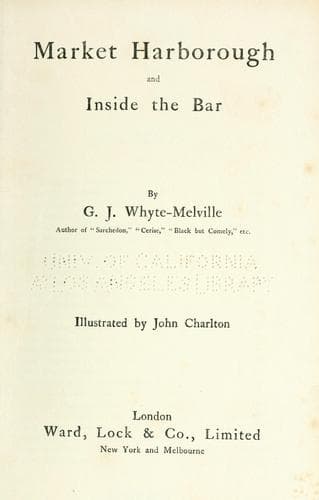
Market Harborough, and Inside the BarWhyte-Melville, G. J. (George John)
General
Market Harborough, and Inside the Bar
Whyte-Melville, G. J. (George John)
Country life -- England -- Fiction; English fiction -- 19th century; Fox hunting -- Fiction
So they plucked me; but I persevered in my course of study
notwithstanding. Do I not know and love Jorrocks? If I could find out
Soapy Sponge in the flesh, would I not ask him to come and stay with me,
and feed him and mount him, and let him smoke as much as he liked in his
bedroom? Nay, I think I would even have bought the piebald pony of him
as a cover hack; for to ride either Sir ’Ercles or Multum-in-Parvo would
have been beyond my highest aspirations. Nay, with all his absurdities
and affectations, I have a sneaking kindness for the dismounted
sportsman in “Ask Mamma” who hung his wet towel out at window on
doubtful nights, though he had not a horse to his name, and was no more
likely to go out hunting than if he had been bed-ridden. Yes, I like the
whole thing—the hounds, the horses, the servants, the second-horse men,
the splashes on my top-boots, the golden drops on the gorse covert, and
the wreath of cigar-smoke curling upward into the mild soft air.
People talk about hunting going out; being on its last legs; civilised
away before the advance of railroads, the march of intellect, &c. All
this is sheer nonsense. There are more men hunt to-day than hunted
twenty years ago, twice as many as hunted thirty, and probably ten times
as many as hunted fifty years ago. Hounds run harder than they did in
the time of our fathers; horses are better bred, better kept, better
bridled, and better ridden. The country is also more enclosed, and there
is consequently a deal more jumping, and more occasion for skill and
quickness, than when High Leicestershire was an open upland, and Naseby
field an unfenced marsh. The best of the old ones could not have gone “a
cracker” in higher form than the dozen or so of men who may be seen any
morning in the week with any of our crack packs of hounds in a quick
thing; and in the “days of Old Meynell” there was a good deal more room
for those who liked to try. It really is by no means an easy matter to
thread a crowd of a hundred horsemen in a narrow lane, all going racing
pace, and then to jockey the best ten or a dozen of these for the
easiest place in the first fence. The actual feat of keeping near hounds
when they run hard requires skill and quickness; but the difficulty is
much enhanced when it has to be performed by a score of men where there
is only comfortable space for five. It is a pleasant sensation, too,
when the first impediment has been disposed of, and a man feels what the
fast ones of the present day call “landed,” to sail away with the
hounds, always supposing he is riding a hunter, and to feel that he will
not now be interfered with till they check, but can do his own places at
his own pace, without pulling his horse out of his stride, and gain all
the advantages of seeing the hounds turn, while he has all the pleasure
of watching them as they shoot across the fields, in swift, streaming
line.
Public-domain text, read in full here on John Shaqi.
Reviews
Reviews
No reviews yet
Be the first to share your thoughts on this work.
Elsewhere in the archive
Join the Discussion
Join the discussion
Sign in to leave a comment or review.
Sign InorCreate an account