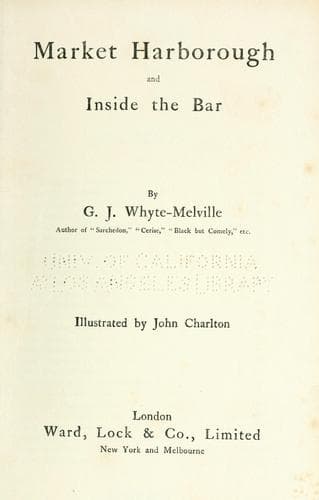
Market Harborough, and Inside the BarWhyte-Melville, G. J. (George John)
General
Market Harborough, and Inside the Bar
Whyte-Melville, G. J. (George John)
Country life -- England -- Fiction; English fiction -- 19th century; Fox hunting -- Fiction
Great artists, indeed, boast that under such favourable circumstances,
they can distinguish and criticise the performances of each individual
of the pack: but for myself I confess that I never had either coolness
or leisure for such details. By the time I have marked the best place in
the next fence, chosen the soundest ridge, or the wettest furrow, by
which to get there, given my hat a firm push down on my head, and
arranged my four reins, which are apt to get confused together and
entangled with the thong of my hunting-whip, in the manner I am
accustomed to hold them, I have small attention to spare for anything
else; and I have always been of opinion that the cheering to particular
hounds in a rapid burst, from huntsmen and other professionals striving
hopelessly to catch them, is the offspring of a vivid imagination, and a
happy audacity in guess-work.
This forward riding, however, to a man who means to ride at all, is
decidedly the best method of crossing a country, both on the
considerations of pleasure and profit. Horses take their leaps in a more
collected form when they see none of their own species in front of them;
the hounds create quite excitement enough in a hunter to make him do his
utmost; while the emulation he conceives of his own kind is apt to
degenerate into a jealousy, that makes him foolhardy and careless. Also
a great amount of unnecessary exertion is entailed upon him, by being
pulled off and set going again, which must be done repeatedly in a run
by a man who follows another, however straight and well his leader may
ride. Also, the sportsman’s nerves are spared much needless anxiety and
misgiving. Can anything be more distressing than to see our front-rank
man fall, in the _uncertainty_ he has attained on the further side of a
thick fence, or cover it with an obvious effort and struggle? Caution
whispers, we had better decline. Shame urges that “what one horse can do
another can.” Self-esteem implores us not to fall back into “the ruck”
behind. So we first of all check our horse from hesitation, and then
hurry him from nervousness. The probable result is a “cropper,” with the
additional disgrace of having been incurred at a place which the pioneer
cleared easily, and an assumption, as unjust as it is unwelcome, that
our horse is not so good as his. Now, in riding _for himself_ a man
preserves his confidence till he is _in the air_. Should he be luckless
enough to light in a chasm, he has at least the advantage of not being
frightened to death in advance; and I am convinced that all the
extraordinary leaps on record have thus been made by these forward
horsemen, who, trusting dame Fortune implicitly, find that she nearly
always pulls them through. With regard to the distance a horse can cover
when going a fair pace and leaping from sound ground, even with thirteen
or fourteen stone on his back, it is scarcely credible to those who have
not witnessed it. Two- and three-and-thirty feet from footmark to
Public-domain text, read in full here on John Shaqi.
Reviews
Reviews
No reviews yet
Be the first to share your thoughts on this work.
Elsewhere in the archive
Join the Discussion
Join the discussion
Sign in to leave a comment or review.
Sign InorCreate an account