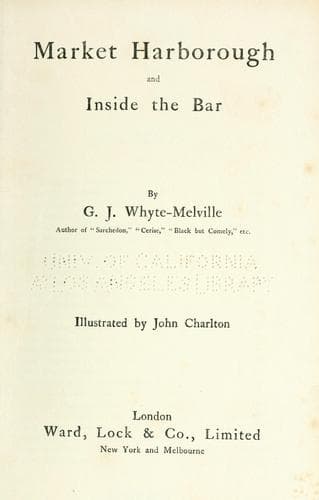
Market Harborough, and Inside the BarWhyte-Melville, G. J. (George John)
General
Market Harborough, and Inside the Bar
Whyte-Melville, G. J. (George John)
Country life -- England -- Fiction; English fiction -- 19th century; Fox hunting -- Fiction
footmark and on a dead level have often been measured off. There are few
fences in any country that would let us in, if we could trust to such a
bound as this; and the activity displayed by a good horse, when he finds
the ditch on the landing side wider than he calculated, is perhaps the
noblest effort of the bodily powers of the animal.[2]
Footnote 2:
In the Black Forest in Germany there are two stones standing to this
day, _sixty feet_ apart, to commemorate the leap made across a chasm
by a hunted deer, attested by several sportsmen who were eye-witnesses
of the wonderful and desperate effort.
Of course, we must fall sometimes. Of course, without that little spice
of what we can hardly call _danger_, but which produces what we may
safely call _funk_, it wouldn’t be half the fan it is. Going down,
indeed! Look at the column of advertisements, weather permitting, in the
_Times_; look at the price of hay and corn; look at the collector’s
accounts of assessed taxes for saddle-horses (if you can get them); look
at Poole’s trade in coats, and Anderson’s in breeches, and Peel’s (not
Sir Robert’s) in boots. Why, the very shoemakers, though on foot, hunt
regularly. So do the tradesmen and the farmers, and all the liberal
professions; the army, the navy, the House of Commons, the Peers of the
realm, her Majesty’s Ministers, and the principal Commissioner of the
Court of Bankruptcy; nay, the heir to the crown is an enthusiastic
sportsman, and an excellent rider; and so _Floreat Diana!_ and God save
the Queen!
Talking of falls brings me back to my broken collar-bone, and the bar of
the Haycock. I must explain, then, how I came to be established as the
habitual inhabitant of that snuggery.
After so wet a summer as that of 1860, I confess I was sanguine as to an
open winter: I have always supported the doctrine of compensation. If we
don’t get it in one way, we do in another. A deal of warmth was
doubtless due on the year, and what was more natural than to anticipate
an open season, and plenty of sport? With this conviction, I kept my
eyes open all the summer, and raising my modest stud from the complement
of three to five, was fortunate enough to purchase at Tattersall’s two
raw-boned, Roman-nosed animals, called respectively “Apple-Jack” and
“Tipple Cider,” who turned out to be sound, useful, and well-trained
hunters. Lest I should delude the unwary into thinking it a good plan
thus to put one’s hand into “the Lucky-bag,” let me observe, that I paid
the full value for them, and esteem myself unusually fortunate not to
have been “stuck,” or, in plain English, cheated out of good money for a
bad horse.
Public-domain text, read in full here on John Shaqi.
Reviews
Reviews
No reviews yet
Be the first to share your thoughts on this work.
Elsewhere in the archive
Join the Discussion
Join the discussion
Sign in to leave a comment or review.
Sign InorCreate an account