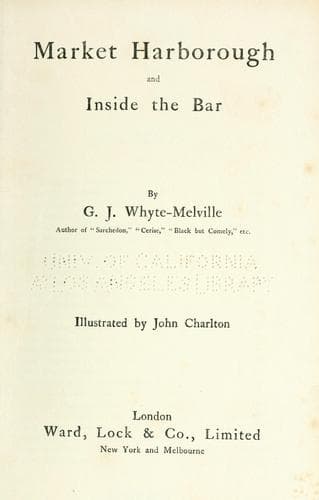
Market Harborough, and Inside the BarWhyte-Melville, G. J. (George John)
General
Market Harborough, and Inside the Bar
Whyte-Melville, G. J. (George John)
Country life -- England -- Fiction; English fiction -- 19th century; Fox hunting -- Fiction
“_Be’ant hurt a mossel!_” exclaimed the child in high glee, scrambling
once more through the hedge, to assist his preserver in righting the
filly, on whom, after properly securing the bridle, he again mounted to
proceed on his errand, with unshaken nerve. The old man was so pleased
with the coolness of the urchin that he begged him of his master, and
took him into his own service, where Tips learned all of horses and
horsemanship that he ever knew, and where he might have remained for
life but that his employer died, and he was thrown upon the world once
more, with nothing but his natural abilities to depend upon.
And here let me lift up my voice, to correct a very erroneous notion,
rife amongst the unsporting portion of the community, to the effect that
rough-riders and that class of persons are men of dissipated habits.
Except in some rare instances, the very contrary is necessarily the
case. No man can preserve that cool, clear-headed daring which we call
nerve, if he addicts himself habitually to the use of stimulants. The
sensitive fibres of the human interior, which when injured and irritated
by alcohol, react upon the courage, spirits, and temper, exist equally
in the rudest day-labourer as in the most delicate fine lady. When these
are affected, the nerve begins to fail, and no man without that quality
can pretend to tame unbroken, or to ride ungovernable horses. Practice
will do much, and unquestionably the alarm created in the biped, by the
hostility of the quadruped, is somewhat disproportioned to the real
danger incurred; nevertheless, our own sensations and our daily
observation of others cannot but prove to us, that there is much truth
in the proverb which says, “He who would venture nothing, must not get
on horseback!” However drunk some of these dare-devil equestrians may be
willing to get on occasion, they are habitually men of temperate and
abstemious habits; almost invariably early risers, and consequently
sound sleepers during the night.
That a hardy, healthy habit of body is indispensable to such persons is
obvious, when we consider the muscular exertion they have to go through,
and the many hard knocks they are likely to sustain in their daily
avocations. We all know that a prize-fighter, in training, is capable of
receiving an amount of punishment without inconvenience, of which a
tithe would knock the same man “out of time” were he not toughened and
hardened against it by the severity of his preparation. The cutting blow
that would raise a swelled and angry sore on the face or person of a man
who had been indulging in gluttony and idleness, leaves but a slight red
mark on the clear skin of the thoroughly purified athlete; and the
latter rises rather refreshed than otherwise from a fall “over the
ropes,” that would have stunned and stupefied the former for an hour,
and given him a bilious attack for a fortnight.
Public-domain text, read in full here on John Shaqi.
Reviews
Reviews
No reviews yet
Be the first to share your thoughts on this work.
Elsewhere in the archive
Join the Discussion
Join the discussion
Sign in to leave a comment or review.
Sign InorCreate an account