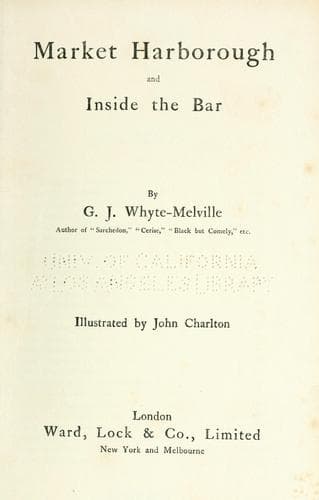
Market Harborough, and Inside the BarWhyte-Melville, G. J. (George John)
General
Market Harborough, and Inside the Bar
Whyte-Melville, G. J. (George John)
Country life -- England -- Fiction; English fiction -- 19th century; Fox hunting -- Fiction
“Far from it, sir,” said he. “Far from it. Bones isn’t broke so easy as
gentlemen think. Ask your pardon, sir; now how was it as _your_ accident
came about? Collar-bone, sir, warn’t it? Well, sir, it wasn’t a _young_
horse as let you down that way, I’ll take upon me to—” swear, he was
going to say, but, looking respectfully at Miss Lushington, Tips put his
broad hand over his mouth, and rounded off his sentence with the word
“suppose.”
I was forced to confess that the culprit Apple-Jack was by no means a
young horse. In fact, he “owned” to ten; and, like seven-and-twenty in a
woman, that is an age at which a horse remains for an indefinite period.
“That’s where it is, sir,” answered Tips. “Now, a young one will spoil
your face sometimes, and strain you in the groin, and kick at you when
you’re down; and I’ve even known of ’em breaking of a man’s ribs. But a
collar-bone?—no. If you’ll excuse _me_, sir, I’ll tell you the reason
why. When a man breaks his collar-bone, ’tis because him and his horse
comes to the ground all of a heap; and a young one never falls all of a
heap without he’s blown, and then he seldom gets to the far side of his
fence at all.”
“You’ve ridden a good many young ones?” I asked, not without some little
admiration of a man who seemed to consider an inexperienced horse the
_safest_ mount.
“Here and there a one, sir,” replied Tips, looking modestly downwards.
“My old master, he bred a good sort; you don’t see many such nowadays.
And I mostly had the schoolin’ of ’em, both with Sir ’Arry and the
Squire. Bless ye, sir, the young ones isn’t the most troublesome as we
have to do with. A young horse is very _teachable_, as I call it; and
the sooner you get him, the easier it is to show him what you mean. A
little timorsome perhaps they are at first, and frightened at what
they’re about. I’ve seen the same with the women-folk.—[Here Miss
Lushington coughed loudly, and frowned.]—But when they _do_ go, they
_mean_ going, and no mistake.—[“Well, I’m sure!” said Miss L., gathering
up her work, and preparing to draw some beer.]—I’d as leave ride a
four-year-old, if he could have the _condition_ in him, as a fourteen.
If things don’t go cross with him at first, to my thinking, he’s the
pleasanter mount of the two.”
“But you don’t mean to say a young horse can jump as well as an old
one!” I exclaimed, completely aghast at such an upsetting of all my
preconceived notions; and recollecting, not without a qualm, how my
banker’s book might testify to the value I placed on seasoned and
experienced hunters. “Suppose you come to ‘doubles’! Suppose you come to
timber! Suppose you want to creep quietly through a gap by a tree!”
Public-domain text, read in full here on John Shaqi.
Reviews
Reviews
No reviews yet
Be the first to share your thoughts on this work.
Elsewhere in the archive
Join the Discussion
Join the discussion
Sign in to leave a comment or review.
Sign InorCreate an account