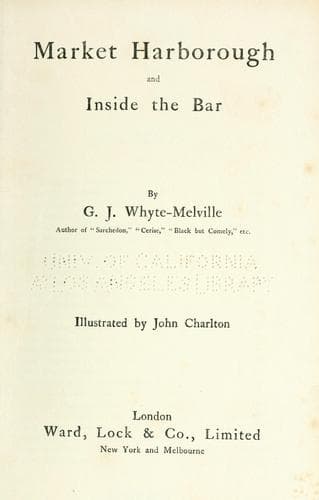
Market Harborough, and Inside the BarWhyte-Melville, G. J. (George John)
General
Market Harborough, and Inside the Bar
Whyte-Melville, G. J. (George John)
Country life -- England -- Fiction; English fiction -- 19th century; Fox hunting -- Fiction
We have now established half-mile races for our two-year-olds, as, with
some few exceptions, the most important events of our English turf—our
very Derbys and St. Legers—are but a scramble of a dozen furlongs, with
little more than the weight of a child on a _very_ young horse’s back.
With all the forcing by which art strives to expel nature, it returns,
in this instance, as Horace says, literally with a stablefork,[3] we
cannot get an animal to its prime at three years old, who ought not to
arrive at maturity till twice that age. Still we continue to breed more
and more for a “turn of speed,” utterly regardless of endurance, till
our famous English racehorses have degenerated into such galloping
“weeds,” that I myself heard an excellent sportsman and high authority
on such matters affirm, in discussing the hounds-and-horses match, which
was to have come off last October, that “he did not believe there was a
horse at Newmarket that could get four miles _at all_; no, not if you
trotted him every yard of the way!”
Footnote 3:
“Naturam expellas _furcâ_, tamen usque recurret.”
This, of course, was a jest; but, like many a random shaft pointed with
a sarcasm and winged with a laugh, it struck not very far off the centre
of the target. Even our hunters, too (and surely, if you want endurance
in any animal alive, it is in a hunter), we are _improving_, year by
year, into a sort of jumping camelopard. Where are the strong,
deep-girthed horses on short legs of thirty years ago? horses that stood
just under sixteen hands, and could carry sixteen stone. Look at what
people call a first-class hunter now! (and it must be admitted that, for
the high price he commands in the market, he ought to be as near
perfection as possible.) Look at him, as you may see him in fifty
different specimens with the Pytchley or Quorn hounds, any hunting-day
throughout the winter! He is a bay or a brown—if the latter, more of a
chocolate than a mottled, with white about his legs and nose. He stands
sixteen two at least, with much daylight underneath him. He has either a
very long weak neck, with a neat head; or more often a good deal of
front and throat, with a general bull-headed appearance, that conveys
the idea of what sailors term “by the bows,” and argues a tendency to
hard pulling, which, to do him justice, he generally possesses. He has
fine sloping shoulders, and can stride away in excellent form over a
grass-field, reaching out famously with his fore legs, which, though
long, are flat, clean, and good. Somehow you are rather disappointed
with him when you get on his back. With no positive fault to find, you
have yet an uncomfortable conviction that he does _not feel like it_;
and, for all his commanding height, you are subjected to no irresistible
temptation to “lark” him. When Mr. Coper asks you three hundred and
takes “two fifty,” as he calls it, alleging the scarcity of horses, the
excellence of this particular specimen, his own unbounded liberality,
Public-domain text, read in full here on John Shaqi.
Reviews
Reviews
No reviews yet
Be the first to share your thoughts on this work.
Elsewhere in the archive
Join the Discussion
Join the discussion
Sign in to leave a comment or review.
Sign InorCreate an account