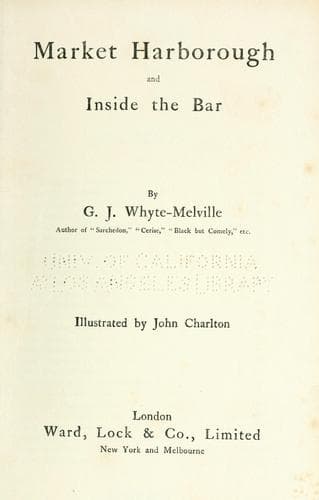
Market Harborough, and Inside the BarWhyte-Melville, G. J. (George John)
General
Market Harborough, and Inside the Bar
Whyte-Melville, G. J. (George John)
Country life -- England -- Fiction; English fiction -- 19th century; Fox hunting -- Fiction
intense respect for yourself, and every other inducement that can
mitigate the painful process of affixing your name to a cheque, you seem
to give him your money without exactly knowing why; but when the new
purchase _stops_ with you in deep ground the first good scenting day,
after you have bustled him along honestly for two-and-twenty minutes,
you think you _do_ know why exactly; and, although you may be, and
probably _are_ disgusted, you cannot conscientiously admit that you are
surprised.
I have not seen these sort of nags, though, in the Soakington country; I
presume they all go to “The Shires;” and this brings me back, after a
long digression, to Tom Turnbull and Apple-tree Farm.
There never was such a farm for coziness and comfort as that. Surrounded
by an ugly though sporting-looking country, it possesses the only
undulating fields for many miles round, and consequently boasts a view
from a certain eminence called Ripley Rise, that commands half-a-dozen
of the Earl’s best fox-coverts, the distant towers of Castle-Cropper
itself, and no less than seventeen church-steeples. There are stately
old elms close to the dwelling-house, and a rich and plentiful orchard,
from which it takes its name, adjoins a snug little walled garden,
celebrated for the earliest summer fruit, and the best plums in the
district—thanks to the late Mr. Naggett, a far-seeing, shrewd old
agriculturist. Apple-tree Farm is a good deal better drained than most
of the adjoining lands; consequently its acres of arable return a
heavier produce, and its upland fields are more calculated for rearing
young horses than any in the country.
Nothing gives a colt such a chance as a fine high and dry pasture, on a
slope, where he can exercise himself in the practice of going up and
downhill, unconsciously strengthening his hocks and acquiring liberty in
his shoulders whilst he is at play.
Horses bred on uplands, too, have a far harder and sounder description
of hoof than those that have been accustomed in youth to splash about in
rank, marshy meadows; and, strange to say, their very coats are finer,
and their whole appearance denotes higher blood than can be boasted by
their own brothers, reared on lower grounds. Those who profess to be
acquainted with the physiology of the horse, affirm that the produce of
Arab stallions and mares, if suffered to breed in the rich wet marshes
of Flanders, would, in half-a-dozen generations, without any sort of
cross, and from the sheer influence of keep and climate, lose every
trace of their noble origin. The Prophet himself would not recognise the
dull-eyed, coarse-shaped, heavy-actioned progeny, for the lithe and
fiery children of the Desert.
Here, then, Tom Turnbull breeds and rears many a good nag, taking care
never to have above one or two at a time, so that sufficient attention
may be devoted to the yearling, and, above all, that it may have plenty
of keep.
Public-domain text, read in full here on John Shaqi.
Reviews
Reviews
No reviews yet
Be the first to share your thoughts on this work.
Elsewhere in the archive
Join the Discussion
Join the discussion
Sign in to leave a comment or review.
Sign InorCreate an account