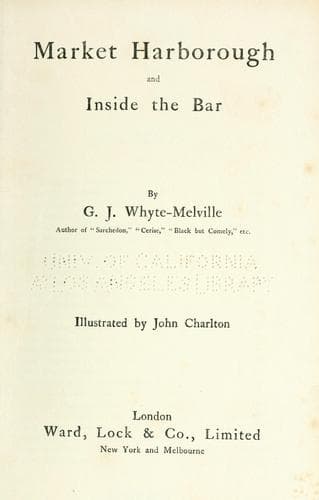
Market Harborough, and Inside the BarWhyte-Melville, G. J. (George John)
General
Market Harborough, and Inside the Bar
Whyte-Melville, G. J. (George John)
Country life -- England -- Fiction; English fiction -- 19th century; Fox hunting -- Fiction
It is difficult to make out whether the aborigines of the country
believed him to be an English relative of The Master’s, or a foreigner
of distinction on a special mission from his Holiness the Pope. Isaac
rather leads us to infer that the latter supposition was the favourite
theory in and about the demesne. Be this as it may, under the auspices
of his patron he soon became, in every sense of the word, a leading
characteristic with “The Flamers,” that celebrated hunt, which has so
often been immortalised in song and story. “Mr. Isaacs,” as he vows he
was always called, drank, talked, and rode with the boldest, the
loudest, and the thirstiest of them. He seems to have ridden in and out
of the celebrated Pound at Ballinasloe, on an average, once every
half-hour, during the two days and nights that well-known horse-fair is
supposed to last; and it was here that Ike distinguished himself by the
great and crowning exploit of his life.
It was in the old fighting, roistering days. Captain Bounceable
quarrelled with Major O’Toole, upon the merits of a “harse,” as each of
the belligerents was pleased to term the noble animal that originated
their differences. The lie which had been _told_ pretty frequently
during the dispute, was at length _given_ with offensive directness; and
nothing but “thunder an’ turf:” pistols and coffee, could be the result.
The time was hard upon midnight; the next morning was Sunday; the
principals, men of the strictest orthodoxy and the soundest
Protestantism. The quarrel could not possibly keep till Monday morning.
Major O’Toole was impatient for action: Captain Bounceable thirsted for
blood. They must have it out then and there, in the inn-garden, without
waiting for daylight.
Except at the two ends of a handkerchief, however, even Irishmen cannot
conveniently fight a duel in the dark. It was proposed, therefore, and
agreed to with considerable cordiality, that each combatant should hold
a lighted torch in his left hand, to direct his adversary’s fire; a
loaded pistol in his right, to return it. But here arose an unexpected
difficulty. Major O’Toole had but one arm; and, although Captain
Bounceable had but one eye, the advantage was obviously on the side of
the latter, in a case of steady pistol practice.
The duel might now have been postponed—perhaps even prevented
altogether—had it not been for the self-devotion of Mr. Isaacs.
“The gentlemen shall not be disappointed,” said Ike—“_I’ll_ see fair,
and hold the candle for both of ’em.”
“Where will you stand?” asked Major O’Toole.
“Halfway between ye,” replied the daring Englishman, “and take the
chance of both of ye missing me. Give us a lantern, though,” he added;
“for the wind’s rising from the south-west.”
“Faith, if it’s a bull’s-eye,” quoth Bounceable, “I’ll be safe to snuff
it out; and we’ll be worse in the dark than ever, for a second shot.”
Public-domain text, read in full here on John Shaqi.
Reviews
Reviews
No reviews yet
Be the first to share your thoughts on this work.
Elsewhere in the archive
Join the Discussion
Join the discussion
Sign in to leave a comment or review.
Sign InorCreate an account