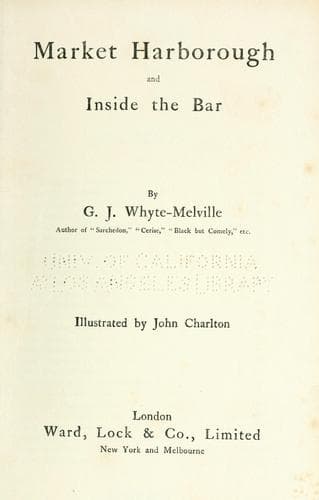
Market Harborough, and Inside the BarWhyte-Melville, G. J. (George John)
General
Market Harborough, and Inside the Bar
Whyte-Melville, G. J. (George John)
Country life -- England -- Fiction; English fiction -- 19th century; Fox hunting -- Fiction
Eight-and-forty hours more saw old Isaac stamping drearily about on the
wet pavement of that excellent sporting locality. Market Harborough,
though perhaps the best head-quarters in the world for fox-hunting, can
scarcely be termed a gay or very beautiful town. On a wet, drizzling
afternoon in early winter, when twilight begins somewhere about 2.45,
with no movable object visible save a deserted carrier’s cart, and a
small rain falling, which dulls the red-brick houses while it polishes
the paved and slippery streets, it is, doubtless, a city suggestive of
repose, not to say stagnation. Isaac’s was a temperament sufficiently
susceptible of all unpleasant influences; and he began to wish heartily
he hadn’t come. A variety of disadvantages had occurred to him since his
arrival. The price of forage and stabling he considered enormous. The
conveniences for hot water were not what he was accustomed to at home.
Hotspur did by no means feed well in a strange box: the horse had begun
to look poorer day by day since he left the dealer’s. And last night The
Boy, who had never been from home before, certainly smelt of gin when he
came to bed.
This youth—who, if he once had a name, must have long forgotten it,
since he was never called anything but “The Boy”—was a continual thorn
in the head groom’s side. He had originally been taken solely on Isaac’s
recommendation, and had caused that worthy more trouble than all the
rest of the establishment put together, horses, pigs, and the
Cochin-Chinas to boot. He was a light, lathy lad, with a pretty face; a
good horseman, considering his strength, or rather weakness; and had a
knack of keeping his hands down: but he owned the usual faults of
boyhood—carelessness, forgetfulness, “_imperence_” (as Isaac called it),
a great love of procrastination, and general insensibility to the beauty
of truth.
“If he takes to drinking, the young warmint!” thought Isaac, “I’ll
larrup the skin off him!” And thus consoling himself, the old man turned
his cheek once more to the chill, misty heavens, and shook his head. His
horses were done up; the door locked, and the key in his pocket; The Boy
also secured by the same means in the loft. Master could not arrive till
eight or nine o’clock. It was the hour when, at The Grange, he was
accustomed to see the pigs feed and the chickens to roost. He wished he
was back in the Old Country: the time hung heavily on the old groom’s
hands.
“Nothing to do, and lots of time to do it in! that seems to be about the
size of it—eh, governor?” said a voice at his elbow; and, turning round,
Isaac confronted a short and dapper personage, whom, by a sort of
freemasonry, he had no difficulty in recognising as one of his own
profession.
At any other time he would have treated this worthy’s advances to
acquaintance with sovereign contempt; but his spirits were depressed and
his heart solitary, so he vented a grunt of acquiescence, which, for
him, was wonderfully polite.
Public-domain text, read in full here on John Shaqi.
Reviews
Reviews
No reviews yet
Be the first to share your thoughts on this work.
Join the Discussion
Join the discussion
Sign in to leave a comment or review.
Sign InorCreate an account