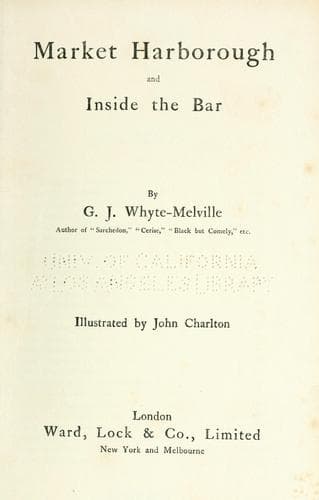
Market Harborough, and Inside the BarWhyte-Melville, G. J. (George John)
General
Market Harborough, and Inside the Bar
Whyte-Melville, G. J. (George John)
Country life -- England -- Fiction; English fiction -- 19th century; Fox hunting -- Fiction
And yet, why not? To be sure, judging from Quizby’s letter and his frank
acknowledgment of an attachment to her in his youth, the lady must have
arrived by this time at middle age, and Plumtree was a mere boy (for,
after all, a man of five-and-twenty is little more than a boy), actually
shaving for whiskers, top-dressing with balm of Columbia, and raising an
abundant crop of pimples as the result. A woman too, after she arrives
at a certain point of maturity, say five-and-thirty, remains for an
incredible period at that attractive stage of her charms. She has lost
indeed the bright freshness of youth; but if she has been really
handsome, she has gained in exchange a certain depth of colouring and
intensity of expression, which are equally efficient weapons of offence.
Then, while the passing years blunt her darts scarcely perceptibly,
every day adds to her experience and dexterity in their use. A
_coquette_ of twenty years’ standing is like an old _maître d’armes_ of
the Empire, cool, wary, dauntless, and skilful; _rusé_ in the art of
destruction, and taught by a hundred combats to take every advantage,
and never to throw a chance away. I have often thought, notwithstanding
the dancing exploit, a man would have been safer with Herodias’s
daughter than with Herodias herself.
Then a young man, if he once suffers himself to be captivated by a woman
considerably his senior, becomes rather childish, not to say imbecile,
in the process. He goes into leading-strings forthwith, and there is no
folly or extravagance of which he is incapable. Shall I ever forget what
a fool young Larkspur made of himself about old Lady Foxglove, who might
have been his mother, and looked as if she _had_ been his wet-nurse? Nor
can I cease to regret the fate of my poor friend Capon, who left college
to run away with Mrs. Mallard the actress, at a period when that lady
had become too aged and infirm for genteel comedy parts at any of the
theatres royal, and of whom I last heard at a French watering-place,
living in cheap lodgings at the head of a grown-up family not his own,
nor indeed, unless scandal be more scandalous than usual, the issue of
the talented Mr. Mallard deceased.
Public-domain text, read in full here on John Shaqi.
Reviews
Reviews
No reviews yet
Be the first to share your thoughts on this work.
Elsewhere in the archive
Join the Discussion
Join the discussion
Sign in to leave a comment or review.
Sign InorCreate an account