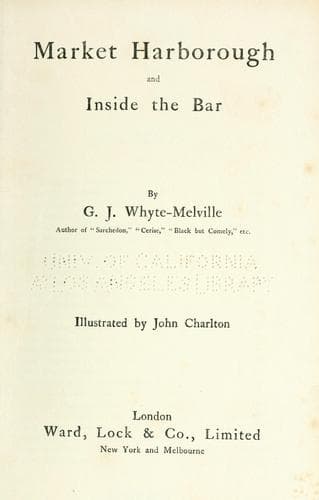
Market Harborough, and Inside the BarWhyte-Melville, G. J. (George John)
General
Market Harborough, and Inside the Bar
Whyte-Melville, G. J. (George John)
Country life -- England -- Fiction; English fiction -- 19th century; Fox hunting -- Fiction
Behold me, then, like a man in a dream, dressing comfortably for dinner,
in a strange house, of which I did not know the proprietor, nor, indeed,
one of the inmates, except the _harum-scarum_ young gentleman who had
introduced me. In justice to myself, I made an elaborate toilet—white
tie, black suit, thin boots—everything rigorously correct. There is no
costume, in my opinion, which so marks the distinction of classes, as
the plain dinner-dress of an English gentleman; and, indeed, I once
heard that very invidious title defined as “a man who had got evening
clothes.” Passing down to the drawing-room—an apartment I had no
difficulty in finding, for the door was open, and a lamp shone
brilliantly from it into the hall—I had leisure to observe the articles
of furniture in the passages, and to remark on the idiosyncrasy which
prompts all country gentlemen alike to ornament the insides of their
houses with stuffed animals in glass cases. The Ashes was rich in
specimens of this description. All kinds of birds flourished their beaks
at the visitors on the stairs. A gigantic pike, like a miniature shark,
grinned at him over the chimney-piece, and a hideous otter snarled at
him from under the umbrella-stand in the hall. A portrait, which I
concluded to be that of Mr. Plumtree senior, also adorned this crowded
vestibule. I studied it by the light of my chamber-candlestick, not
entirely, I fear, without spilling some wax on the floor during the
process, in pardonable curiosity as to the exterior of the gentleman
with whom I was about to dine. The picture was in all probability more
valuable from its resemblance to the original, than from any intrinsic
merit of its own as a work of art. It represented a florid personage, in
the prime of life, attired in a bright-blue coat, and yellow waistcoat,
on both which articles of apparel the artist had bestowed a liberal
amount of colour, sitting by a pillar of porphyry, under a crimson
curtain, “with a distant view of the changing sea.” His face, devoid of
any outward expression, denoted that rapt state of thought peculiar, I
am informed, to the highest order of intellects, and he seemed equally
unmoved by the magnificence of the scenery, the gorgeousness of the
curtain which overhung him, or the splendour of a heavy watch-chain and
seals that rested massively against his nankeen stomach. On a table at
his elbow stood a large book and a snuff-box, whilst his hand rested
carelessly on the head of a black retriever dog. “If old Plumtree is
like that,” was my mental observation, “he must present as great a
contrast to the Jovial as was ever afforded in the inconvenient
relationship of father and son.” I did not speak aloud, fortunately; for
this conclusion brought me into the drawing-room, which, having dressed
early, I expected I should have had to myself: it was not so, however.
On entering that apartment—a pretty, well-furnished, long, low room,
with some excellent prints and a grand pianoforte—I was somewhat
Public-domain text, read in full here on John Shaqi.
Reviews
Reviews
No reviews yet
Be the first to share your thoughts on this work.
Elsewhere in the archive
Join the Discussion
Join the discussion
Sign in to leave a comment or review.
Sign InorCreate an account