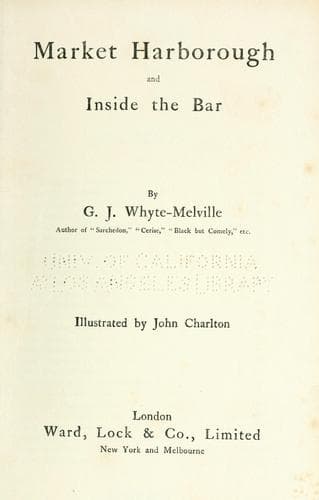
Market Harborough, and Inside the BarWhyte-Melville, G. J. (George John)
General
Market Harborough, and Inside the Bar
Whyte-Melville, G. J. (George John)
Country life -- England -- Fiction; English fiction -- 19th century; Fox hunting -- Fiction
discomfited to find it already occupied by two young ladies, dressed, as
far as my confusion permitted me to observe, precisely alike, sitting in
precisely the same attitude, and engaged over similar pieces of
crochet-work. I bowed very awkwardly, and walked up to the fire, with
the startling intelligence that it was “a cold evening,” a proposition
neither of the ladies seemed in a position to confute. This masterly
manœuvre, however, gave me an opportunity of studying both their faces,
and I am bound to admit that the one predominating idea present to my
mind, during a perusal of their features, was, “How shall I ever know
one from the other, when their brother comes down, and formally
introduces us?” Each of them was a rather tall, rather large young lady,
with hands and feet to correspond. Each of them had a certain regularity
of features, totally devoid of any expression whatsoever, that might
have laid claim to good looks, had it not been nullified by the absence
of colouring and want of tone in their rather large, rather flat faces.
If either of them had unfortunately taken to drinking, she would have
been a bad likeness of her brother the Jovial. That I longed ardently
for the conclusion of that gentleman’s toilet is no matter of surprise,
the conversation between the Misses Plumtree and myself being driven, so
to speak, at a funereal rate, and in the longest possible stages. I
gathered, however, from a certain decision of tone in their few and
disjointed remarks, that there was no mother Plumtree, and that the
vestals now before me were the presiding goddesses of the place.
At length, to my great relief, I heard a door open on the staircase, and
a manly step approaching, which I feared, even while I listened, was too
ponderous for that of my friend. The young ladies made a rustling kind
of movement, as if to bespeak my attention. A deep voice in the hall was
heard to say, “Dinner directly!” and the portly form of mine host walked
into the drawing-room, with outstretched hand, and that welcome on his
lips with which an Englishman always receives a guest into his castle,
whether that metaphorical building be really a ducal residence, a
squire’s hall, or a day-labourer’s cottage.
Old Mr. Plumtree was a great improvement on his son, as well as his
picture. Although of the plainest and most unsophisticated of squires,
he was obviously a high-bred gentleman; and his old-fashioned attire—for
he had not discarded the blue coat, yellow waistcoat, and white
stockings of his younger days—was perfectly in keeping with his fresh
old face, round and rosy as a winter-apple: his fine bald head and
stately figure, deep of chest, stout of limb, and somewhat protuberant
of stomach.
Public-domain text, read in full here on John Shaqi.
Reviews
Reviews
No reviews yet
Be the first to share your thoughts on this work.
Elsewhere in the archive
Join the Discussion
Join the discussion
Sign in to leave a comment or review.
Sign InorCreate an account