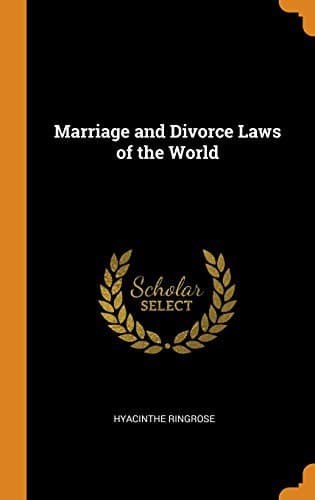
Marriage and Divorce Laws of the WorldRingrose, Hyacinthe
History
Marriage and Divorce Laws of the World
Ringrose, Hyacinthe
Divorce -- Law and legislation; Marriage law
The supposed decease of one of the contracting parties, either through
absence or disappearance, will not enable the other to marry again. So
long as the decease of one of the contracting parties, either through
absence or disappearance, has not been absolutely proved, the marriage is
not considered as dissolved.
ANNULMENT OF MARRIAGE.--A marriage may be annulled when it was contracted
in violation of some legal impediment, or for want of proper consent.
SECOND OR FURTHER MARRIAGES.--A woman cannot marry again for ten months
after a dissolved or annulled marriage, unless she was left pregnant, in
which case she may marry after having given birth to the child.
PROOF OF MARRIAGE.--A marriage must be proved by certificate, or copy
thereof, of such marriage. If it is impossible to produce the certificate,
or its copy, all other means of proof will be allowed, but these other
proofs will not be admitted unless it is previously established that such
certificate or copy cannot be produced.
CHAPTER XXIX.
THE UNITED STATES OF BRAZIL.
The United States of Brazil (_Estados Unidos do Brazil_), the largest
country in South America and one of the most extensive political
subdivisions of the world, is a Republic comprising twenty States and a
Federal District.
Its present constitution was adopted February 24, 1891, and is in many
respects similar to that of the United States of America.
The legislative power is vested in the President of the Republic and a
National Congress, consisting of a Senate and Chamber of Deputies.
The individual States are governed by their governors and legislatures,
and possess their own judicial systems.
The main body of the civil law has its origin in the Portuguese Code and
in the judicial precedents of Portugal.
There is a Supreme Federal Court of Justice, which sits at the capital,
Rio de Janeiro, and Federal Courts in each of the twenty States.
Ninety-nine per centum of the people of Brazil are Roman Catholics and
consider marriage as a religious sacrament, but the law of the land
considers it simply as a civil contract.
MARRIAGE.--The Civil Code defines marriage as a perpetual contract between
two persons of different sex to live together and establish a legitimate
family.
A civil or legal celebration of marriage is compulsory for all persons,
irrespective of race or creed. If after the civil marriage the parties may
desire to satisfy their consciences and the mandates of their church or
sect by having the marriage solemnized in a religious form, there is no
legal objection thereto.
Marriage is forbidden:
1. Of minors under the age of 21 years, unless with parental consent.
2. Of persons of adult age who are incapable of properly governing
themselves or their estates, without the authorization of their legal
representatives.
3. Of an adulterous wife with her accomplice who has been condemned for
the offence.
Public-domain text, read in full here on John Shaqi.
Reviews
Reviews
No reviews yet
Be the first to share your thoughts on this work.
Elsewhere in the archive
Join the Discussion
Join the discussion
Sign in to leave a comment or review.
Sign InorCreate an account