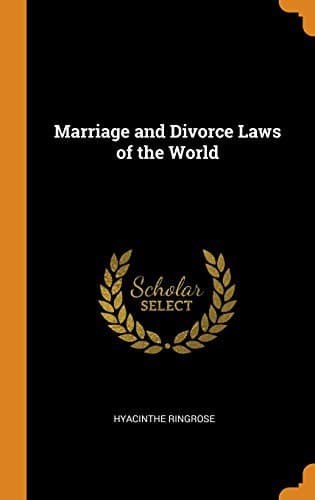
Marriage and Divorce Laws of the WorldRingrose, Hyacinthe
History
Marriage and Divorce Laws of the World
Ringrose, Hyacinthe
Divorce -- Law and legislation; Marriage law
4. Of a wife or widow who has been condemned as the principal or
accomplice of the crime of homicide with a principal or accomplice in the
same crime.
5. Of a person bound by solemn vows of religion to a life of chastity.
The canon law of the Roman Catholic Church is accepted as defining the
religious rules and spiritual effects of marriage, but the civil law
defines the status and temporal effects of the marriage contract.
PROHIBITED MARRIAGES.--The following persons are forbidden to marry each
other:
1. Ascendants and descendants.
2. Persons related collaterally in the second degree.
3. Males who have not completed their fourteenth year and females who have
not completed their twelfth year of age.
4. Persons already bound by marriage.
PRELIMINARIES.--The intending parties must present themselves in person
before the registrar and produce certificates showing:
A. Full names, ages, occupations and domiciles of the contracting
parties.
B. The full names, ages, occupations and domiciles of their parents, or,
if they are dead, the same particulars of those who replace them _in loco
parentis_.
C. Proof of the consents of such persons who in law are entitled to give
or withhold consent to the proposed marriage.
D. A declaration in writing by two respectable witnesses of full age,
certifying acquaintance with the contracting parties, and knowledge that
they are not related within the prohibited degrees of kinship.
If either of the contracting parties has been previously married, proof of
the death of the former spouse must be given to the registrar.
Upon receiving satisfactory proof as stated above, the registrar must post
a notice of the proposed marriage in a conspicuous place in his office,
which notice informs all interested persons to file their objections, if
any they have, in the registry within fifteen days. If at the end of this
period no valid objection to the marriage has been formulated the civil
officer proceeds to the celebration of the marriage.
A marriage concluded before a civil officer in the form established by the
civil law of Brazil can only be annulled by a civil court.
DIVORCE.--The law of the Republic does not permit of an absolute divorce
for any cause whatsoever. A true marriage can only be dissolved by the
death of one of the parties.
JUDICIAL SEPARATION.--A separation of the person and goods may be had for
the following causes:
1. Adultery of the wife.
2. Adultery of the husband, if such adultery creates a public scandal, or
if the husband brings his concubine into the home he has established for
his wife.
3. Sentence of one of the spouses to life imprisonment.
4. Cruel and ill-human treatment.
Public-domain text, read in full here on John Shaqi.
Reviews
Reviews
No reviews yet
Be the first to share your thoughts on this work.
Elsewhere in the archive
Join the Discussion
Join the discussion
Sign in to leave a comment or review.
Sign InorCreate an account