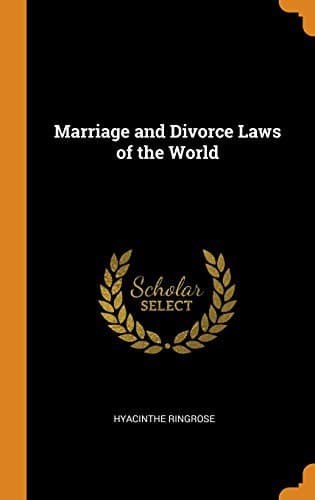
Marriage and Divorce Laws of the World — John Shaqi
Marriage and Divorce Laws of the WorldRingrose, Hyacinthe
History
Marriage and Divorce Laws of the World
Ringrose, Hyacinthe
Divorce -- Law and legislation; Marriage law
The judge, upon seeing and hearing the petitioner and after having made
such comment as he may deem proper, will affix his order to the end of the
petition, directing the parties to appear before him on a day and at the
hour then fixed, and will direct an officer to serve the citation upon the
defendant.
It is within the judge's discretion to grant leave in the same order to
the petitioner to reside separate during the pendency of the action from
the defendant. If the petitioner be a wife, the judge may fix the place of
her temporary residence.
The next step is that upon the day appointed in the citation the judge
hears the parties in person. Upon such hearing it is the duty of the judge
to do his best to conciliate the parties. In case the parties refuse to be
conciliated, or the defendant defaults in appearance, the judge then
grants an order certifying to the fact and giving the petitioner leave to
issue a citation requiring the defendant to appear in court.
The judge has authority under the code to make such a provisional order
respecting the payment to a wife of alimony during the action or
concerning the temporary custody of the children as may be necessary and
proper.
The case is prepared, investigated and judged in the ordinary form, the
Ministère Public being heard. The Ministère Public is an official who
performs similar duties to those of a King's Proctor in England.
The petitioner can at any stage of the case change the petition for a
divorce into a petition for a judicial separation.
NEWSPAPER REPORTS.--The public press is forbidden under penalty of a fine
of from 100 to 2,000 francs to publish the evidence in divorce trials.
EFFECTS OF DIVORCE.--Parties who have been divorced cannot become husband
and wife again if either of them, after the divorce, have contracted a new
marriage since the divorce and been divorced a second time.
If parties who have been divorced wish to become husband and wife again a
new marriage is necessary. After such a remarriage no new petition for
divorce can be entertained for any cause, except that one of the parties
since the remarriage has been sentenced to a punishment which involves
corporal detention and is branded with infamy.
A divorced woman cannot remarry until ten months after the divorce has
become absolute.
Where the divorce has been granted on the ground of adultery the guilty
party can never marry the person with whom he or she was found guilty of
the offence.
CUSTODY OF CHILDREN.--The custody of the children belongs to the party in
whose favour the judgment of divorce has been pronounced, unless the court
in the interests of the children, upon the application of the family or
the Ministère Public, directs that they be entrusted to the other party or
to a third person.
Public-domain text, read in full here on John Shaqi.
Reviews
Reviews
No reviews yet
Be the first to share your thoughts on this work.
Join the Discussion
Join the discussion
Sign in to leave a comment or review.
Sign InorCreate an account