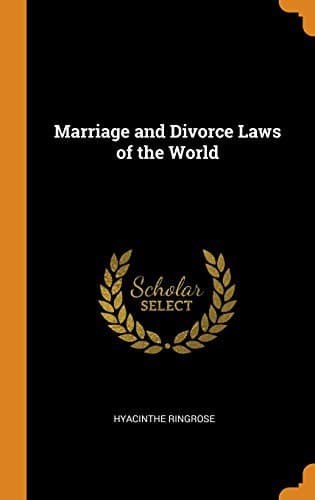
Marriage and Divorce Laws of the WorldRingrose, Hyacinthe
History
Marriage and Divorce Laws of the World
Ringrose, Hyacinthe
Divorce -- Law and legislation; Marriage law
The German Civil Code (_Bürgerliches Gesetzbuch für das Deutsche Reich_),
which became law on January 1, 1900, has been described by Professor
Maitland as "the most carefully considered statement of a nation's law
that the world has ever seen." It is in the Fourth Book of this scientific
codification, under the general title of Family Law, that we find the
German statutes of to-day on marriage and divorce. A summary of these
statutes follows:
MARRIAGE.--Religious definitions, dogmas and obligations respecting
marriage are not affected or considered by the German Code. Marriage is
treated as a civil contract to which the State is always an added party.
A legitimate child requires, before the completion of his twenty-first
year, the approval of his father for concluding a marriage; an
illegitimate child requires, before reaching maturity, the approval of the
mother. A male reaches his majority at twenty-one years of age and a
female at the completion of her sixteenth year, for the purpose of
marriage.
IMPEDIMENTS TO MARRIAGE.--A marriage cannot be concluded between relatives
by blood in the direct line nor between brothers and sisters of full blood
or half blood, nor between persons one of whom has had sexual intercourse
with the parents, grandparents or descendants of the other.
Persons in the military service, aliens and officials who by the law
require special permission to become married cannot conclude a marriage
without permission.
FORM OF MARRIAGE.--A marriage is concluded by the parties appearing
together and declaring before a registrar, in the presence of two
witnesses, their intention to become husband and wife.
VOIDABLE MARRIAGES.--A marriage may be avoided by a spouse who has been
induced to enter the marriage status by fraud concerning such facts as
would have deterred him or her from concluding the marriage had he or she
been acquainted with the actual state of affairs. A marriage cannot be
avoided on the ground of fraud or misrepresentation as to the pecuniary
means of either party.
HUSBAND AND WIFE.--The parties are mutually bound to live in conjugal
community. The right to decide in all matters affecting the common
conjugal life belongs to the husband. However, if the decision of the
husband on these matters is an abuse and not a reasonable exercise of his
right the wife is not bound to accept his decision.
Public-domain text, read in full here on John Shaqi.
Reviews
Reviews
No reviews yet
Be the first to share your thoughts on this work.
Join the Discussion
Join the discussion
Sign in to leave a comment or review.
Sign InorCreate an account