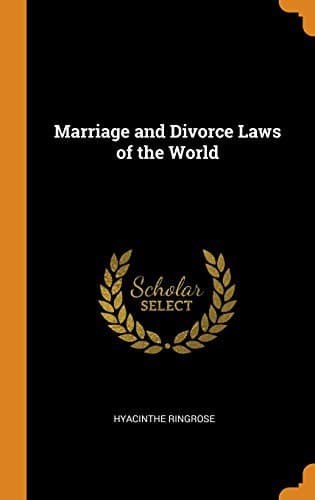
Marriage and Divorce Laws of the World — John Shaqi
Marriage and Divorce Laws of the WorldRingrose, Hyacinthe
History
Marriage and Divorce Laws of the World
Ringrose, Hyacinthe
Divorce -- Law and legislation; Marriage law
Marriage may be absolutely dissolved by means of a bill of divorcement
given by the man to the woman, with the mutual agreement of both parties.
This cannot take effect at once, but there must be three attempts at
reconciliation, either by the rabbi or by the court, or by both.
The Austrian law also permits a divorce among Jews for the proven adultery
of the wife, in which case he can give her a bill of divorcement without
her consent. A Jewish woman cannot obtain a divorce because of the
adultery of her husband.
JUDICIAL SEPARATION.--A judicial separation may be granted for the
following causes:
1. By mutual consent.
2. Conviction of either spouse for adultery or a crime.
3. Malicious abandonment.
4. Conduct endangering the life or health of spouse seeking relief.
5. Incurable disease united with danger of contagion.
6. Cruel and abusive treatment.
CHAPTER XI.
HUNGARIAN MARRIAGE AND DIVORCE LAWS.
In Hungary proper and Transylvania, together with Fiume and certain parts
of the Military Boundary, the marriage law of 1894, supplemented by the
Civil Registration Act of the same year, is in operation for all citizens,
without regard to religious sect.
In Croatia and Slavonia, which, although legally parts of the Kingdom of
Hungary, are autonomous in domestic affairs; three separate systems of
marriage regulation are in force governing, respectively, the Catholics,
the Oriental Greeks, and the Protestants and Jews.
HUNGARY PROPER AND TRANSYLVANIA.--Civil marriage is the only form
recognized by law.
MARRIAGE QUALIFICATIONS.--A man cannot marry before the conclusion of his
eighteenth year; a woman, before the conclusion of her sixteenth year. A
minor cannot conclude a marriage without the consent of his or her legal
representative.
IMPEDIMENTS.--1. Marriage is forbidden between ascendants and descendants.
2. Between brother and sister.
3. Between brother or sister and offspring of brother or sister.
4. Marriage between a person who has been previously married and a blood
relative in direct line of that person's former consort is forbidden.
5. First cousins may not conclude marriage, except on dispensation from
the Minister of Justice.
6. No person may conclude a marriage with any one who has been legally
sentenced for a murder or a murderous assault committed on the former's
consort, even if the sentence has not yet entered into effect.
7. No one may conclude a marriage without the consent of his
ecclesiastical superiors if he has taken ecclesiastical orders or vows
which, according to the law of the church to which he belongs, prevent his
marrying.
8. So long as the guardianship continues, marriage is prohibited between a
guardian or his offspring and the ward.
Public-domain text, read in full here on John Shaqi.
Reviews
Reviews
No reviews yet
Be the first to share your thoughts on this work.
Join the Discussion
Join the discussion
Sign in to leave a comment or review.
Sign InorCreate an account