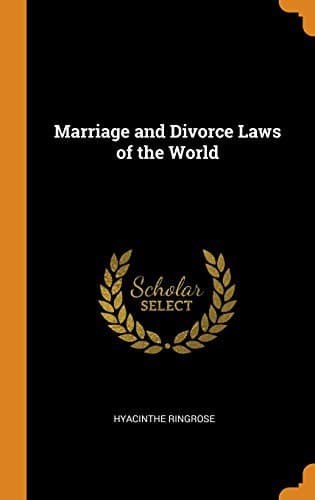
Marriage and Divorce Laws of the WorldRingrose, Hyacinthe
History
Marriage and Divorce Laws of the World
Ringrose, Hyacinthe
Divorce -- Law and legislation; Marriage law
Divorces of domiciled foreigners are granted in several countries of
Europe, provided the cause relied on is a cause for divorce in the native
country of the parties, and in most continental countries divorces of
natives are granted, whether domiciled in their native country or not, the
foundation of jurisdiction being nationality, not domicile. Practically in
all countries the exercise of jurisdiction for divorce is not affected by
the fact that marriage was celebrated in or out of the country.
The causes for divorce are varied in kind and in number. In some countries
of Europe mutual consent is a sufficient cause under certain restrictions.
The number of causes for divorce in Europe vary from one in England to
twelve in Sweden.
The dream of the academic lawyer is for an international law of marriage
and divorce, but the differences between the existing judicial systems of
the various great commonwealths of the world are much too great to make a
universal law on the subject practicable. In one country only the civil
marriage is legal and in another only the ecclesiastical alliance is
valid; in one country divorce is allowed, and in another it is denied; in
one, difference in religion between the parties is an impediment to
marriage, and in another it is not; in one the canon law is controlling,
and in another the civil law regulates all questions of matrimonial
rights. Even in the matter of age and capacity the greatest variableness
exists. As, for instance, the minimum age for marriage. In England it is
fourteen for males and fifteen for females; in Germany, twenty-one for
males and sixteen for females; In Austria, fourteen for both; in Russia,
France, Holland, Switzerland and Hungary, eighteen for males and sixteen
for females; in Spain and Greece, fourteen for males and fifteen for
females; in Denmark and Norway, twenty for males and fourteen for females;
in Sweden, twenty-one for males and seventeen for females; in Finland,
twenty-one for males and fifteen for females; in Servia, seventeen for
males and fifteen for females.
It will be observed that the different laws as to the minimum age for
marriage do not flow from circumstances of climate, religion or culture,
but are mainly historical and arbitrary.
CHAPTER II.
ENGLAND.
INTRODUCTION.--The law of England regards marriage as a contract, a status
and an institution. As a contract it is in its essence an expressed
consent on the part of a man and woman, competent to make the contract, to
cohabit with each other as husband and wife, and with each other only. As
Lord Robertson says: "It differs from other contracts in this, that the
rights, obligations or duties arising from it are not left entirely to be
regulated by the agreement of parties, but are to a certain extent matters
of municipal regulation, over which the parties have no control by any
declaration of their will."
Public-domain text, read in full here on John Shaqi.
Reviews
Reviews
No reviews yet
Be the first to share your thoughts on this work.
Join the Discussion
Join the discussion
Sign in to leave a comment or review.
Sign InorCreate an account