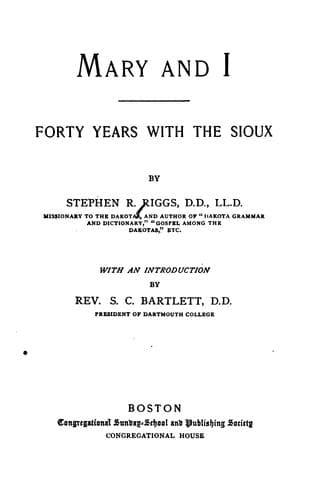
Mary and I: Forty Years with the SiouxRiggs, Stephen Return
History
Mary and I: Forty Years with the Sioux
Riggs, Stephen Return
Dakota Indians -- Missions; Riggs, Stephen Return, 1812-1883
A part of the plan of our new community was a mission boarding-school.
Almost from the beginning, we had been making trial of educating
Dakota children in our own families. Mary had a little girl given her
the first fall after we came to Lac-qui-parle; she was the daughter of
Eagle Help, my Bible reader; but after she had washed and dressed her
up she stayed only a month, and then ran away. The Messrs. Pond raised
one or two in their families. Dr. Williamson had several Dakota
children when at Kaposia, and afterward at Pay-zhe-hoo-ta-ze. Mr.
Adams had at one time a boarding-school of a half-dozen at
Lac-qui-parle, and we had two or three in our family. Now the work was
to be attempted on a larger scale.
The Hazelwood boarding-school was for a while cared for by Miss Ruth
Pettijohn, and afterward by Mr. and Mrs. H. D. Cunningham. Counting
those in Dr. Williamson's family and our own, the boarding scholars
amounted to twenty. This was the extent of our ambition in that line
at that time. A large boarding-school demands a large outlay for
buildings, as well as for its continual support. The necessities of
our mission work did not then demand the outlay, nor could it have
been easily obtained from the funds of the Board. Connected with this
school, as teachers, were Mrs. Annie B. Ackley and Miss Eliza Huggins
and Isabella B. Riggs.
* * * * *
We had reached the time, in 1854, when it became necessary to enter
upon some plan to educate our children beyond what we could give them
in our Indian home. Three years before this, Alfred had been at school
in Illinois, but that was only a temporary arrangement; now he was
seventeen years old and prepared to enter college. Mary and I often
discussed the question of ways and means. It was our desire to give
our children as good an education as we possessed ourselves--at least,
to give them a chance of obtaining such an education. We did not feel
that our position as missionaries should make this impossible, and yet
how it was to be accomplished we could not see. We had neither of us
any patrimony. In this respect we were on an equality. She received
$100 from her father's estate, and I but a little more than that, and
we did not know of any rich friends to whom we could apply for aid.
Our salary had been small from the beginning. We entered the mission
work at a time when the Board was cutting down everywhere. So that we
started on a salary or allowance of about $250, and for the first
quarter of a century it did not materially differ from the basis of a
Methodist circuit rider in the West of olden times; that is, $100
apiece, and $50 for each child. At this time, when our family numbered
eight, we had an allowance of $500. We were both close calculators,
and we never ran in debt. We could live comfortably with our children
at home, each doing something to carry the burdens of life. But how
could we support one or more away at school? A third of the whole
Public-domain text, read in full here on John Shaqi.
Reviews
Reviews
No reviews yet
Be the first to share your thoughts on this work.
Elsewhere in the archive
Join the Discussion
Join the discussion
Sign in to leave a comment or review.
Sign InorCreate an account