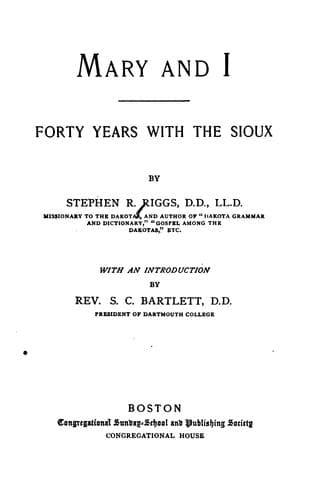
Mary and I: Forty Years with the SiouxRiggs, Stephen Return
History
Mary and I: Forty Years with the Sioux
Riggs, Stephen Return
Dakota Indians -- Missions; Riggs, Stephen Return, 1812-1883
We had been long enough schooling ourselves in the use of the
whip-saw. That was one of the processes of labor that, years before, I
had determined not to learn. I had acquired some skill in the use of
the broadaxe, and rather liked it. I had applied my knowledge of
mathematics in various ways to the work of framing houses, and it
became a pleasure. But I thought I should avoid the whip-saw. The
time, however, came when I needed a sawyer greatly, and could obtain
none, and so took hold myself.
But now we decided that it would be more economical to make boards by
horse and ox power than by man power alone; and so the committee at
Boston authorized the purchase of a small circular saw-mill. This
proved quite a help in our civilized community. It enabled us to put
up in the next season a house for a small boarding-school, and also a
neat church building. This latter was erected and finished at a cost
of about $700, only $200 of which was mission funds. At this time the
Indians were receiving money annuities. It was paid them in gold,
about $10 for each individual. So that the men received from thirty to
fifty dollars. At a propitious time I made a tea-party, which was
attended by our civilized men largely, and the result was that, with
some assistance from white people, they were able to raise about five
hundred dollars. It was a success beyond my most sanguine
expectations.
We had now such a respectable community of young men, who had cut off
their hair and exchanged the dress of the Dakotas for that of the
white man, and whose wants now were very different from the annuity
Dakotas generally, that we took measures to organize them into a
separate band, which we called the Hazelwood Republic. They elected
their President for two years, and other needed officers, and were,
without any difficulty, recognized by the agent as a separate band. A
number of these men were half-breeds, who were, by the organic law of
Minnesota, citizens. The constitution of the State provided that
Indians also might become citizens by satisfying a court of their
progress in civilization.
A few years after the organization of this civilized community, I took
eight or ten of the men to meet the court at Mankato, but, the court
deciding that a knowledge of English was necessary to comply with the
laws of the State, only one of my men was passed into citizenship.
Public-domain text, read in full here on John Shaqi.
Reviews
Reviews
No reviews yet
Be the first to share your thoughts on this work.
Elsewhere in the archive
Join the Discussion
Join the discussion
Sign in to leave a comment or review.
Sign InorCreate an account