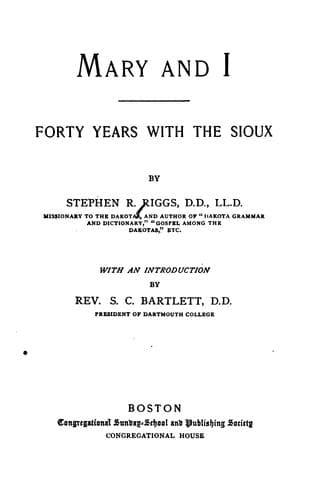
Mary and I: Forty Years with the SiouxRiggs, Stephen Return
History
Mary and I: Forty Years with the Sioux
Riggs, Stephen Return
Dakota Indians -- Missions; Riggs, Stephen Return, 1812-1883
And, as an attraction to the Dakotas, a full-page picture
has been generally added.
In starting the paper, the main object proposed was to stimulate
education among the Dakotas, so that we were not disappointed to find
that, in addition to all that came in from subscriptions, several
hundred dollars were required from the missionary funds to square up
the year. But we lived in hope, and do so still, that the time will
come when the enterprise will be self-supporting. It has proved itself
to be an exceedingly important assistant in our missionary work, which
we can not afford to let die.
* * * * *
With the homesteaders on the Big Sioux, on the 23d of June, 1871, we
held our first general conference of the Dakota churches.[7] From the
Sisseton Agency there went down John B. Renville, Daniel Renville, and
Solomon, of the pastors, with several elders and myself. Dr.
Williamson came up from St. Peter; and John P. Williamson, A. L.
Riggs, and Artemas Ehnamane, and others, came over from the Missouri
River. Year by year, from that time on, we have continued to hold
these meetings, and they have constantly increased in interest and
importance. On this first occasion, four or five days were spent, and
religious meetings held each day. The circumstances by which we were
surrounded intensified the interest. As yet there was no church or
school-house in which we could assemble, and our meetings were held
out-of-doors, or under a booth in connection with Mr. All Iron's
cabin.
[7] This was preliminary to the regularly organized conference
which met the next year.
This colony of more than one hundred church members had located near
the eastern line of Dakota Territory, in the beautiful and fertile
valley of the Big Sioux River. Their settlement lay along that stream
for twenty-five or thirty miles, its centre being about forty miles
above the thriving town of Sioux Falls.
The most of these men were in 1862 engaged in the Sioux outbreak in
Minnesota. For three years they were held in military prisons.
Meanwhile, their families and the remnants of their tribe had been
deported to the Missouri River; so that when they found themselves
together again, it was at Niobrara, Neb., or soon afterward at the
newly established Santee agency a few miles below.
Public-domain text, read in full here on John Shaqi.
Reviews
Reviews
No reviews yet
Be the first to share your thoughts on this work.
Elsewhere in the archive
Join the Discussion
Join the discussion
Sign in to leave a comment or review.
Sign InorCreate an account