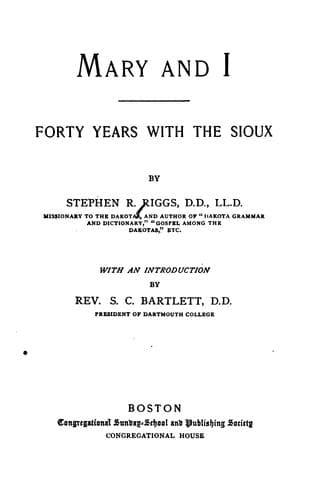
Mary and I: Forty Years with the SiouxRiggs, Stephen Return
History
Mary and I: Forty Years with the Sioux
Riggs, Stephen Return
Dakota Indians -- Missions; Riggs, Stephen Return, 1812-1883
What impulse stirred them up to break away from their own tribe, to
which they had but just returned, and try the hard work of making a
home among coldly disposed if not hostile whites? What made them leave
all their old traditional ties and relationships and go forth as
strangers and wanderers? It must be borne in mind that they left
behind them the food which the government issued weekly on the agency,
to seek a very precarious living by farming, for which they had
neither tools nor teams. They also gave up the advantage of the yearly
issue of clothing, and the prospect of such considerable gifts of
horses, oxen, cows, wagons, and ploughs, as were distributed
occasionally on the agency. More than this: those who had already
received such gifts from the United States Indian Civilization Fund
had to leave all behind, though they went out for the very purpose of
seeking a higher civilization. They went forth in the face, moreover,
of great opposition and derision from the chiefs of their tribe. The
United States Indian agent was also against them. Whence, then, did
they have the strength of purpose which enabled them to face all this
opposition, brave all these dangers?
The germs of this movement are only to be found in the resolves for a
new life made by these men when in prison! There all were nominally,
and the larger part were really, converted to Christ. All of them in
some sense experienced a conversion of thought and purpose. There they
agreed to abolish all the old tribal arrangements and customs. Old
things were to be done away, and all things were to become new. And as
they had been electing their church officers, so they would elect the
necessary civil officers.
But when they came to their people they found the old Indian system in
full power, backed by the authority of the United States. Of the old
chiefs who ruled them in Minnesota, Little Crow and Little Six, the
leaders of the rebellion, were dead; but the others, who had been kept
out of active participation, not by their loyalty to the United
States, but by their jealousy of these leaders, had saved their necks
and were again in power. A few had been appointed to vacancies by the
United States agent, and the ring was complete. And our friends were
commanded at once to fall in under the old chiefs before they could
receive any rations. They must be Indians or starve! Nothing was to be
hoped for from within the tribe, nor from Washington. The Indian
principle was regnant there also. Nothing was left to them but to seek
some other land. One said: "I could not bear to have my children grow
up nothing but Indians"; so they all felt.
Public-domain text, read in full here on John Shaqi.
Reviews
Reviews
No reviews yet
Be the first to share your thoughts on this work.
Elsewhere in the archive
Join the Discussion
Join the discussion
Sign in to leave a comment or review.
Sign InorCreate an account