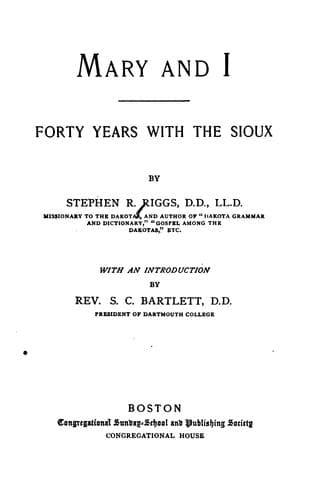
Mary and I: Forty Years with the SiouxRiggs, Stephen Return
History
Mary and I: Forty Years with the Sioux
Riggs, Stephen Return
Dakota Indians -- Missions; Riggs, Stephen Return, 1812-1883
They made their hegira in March, 1869. In this region this is the
worst month in the year, but they had to take advantage of the absence
of their agent and the chiefs at Washington. Twenty-five families went
in this company. A few had ponies, but they mostly took their way on
foot, packing their goods and children, one hundred and thirty miles
over the Dakota prairies. About midway a fearful snow-storm burst upon
them. They lost their way, and one woman froze to death. The next
autumn fifteen other families joined them, and twenty more followed
the year after. Even one of the chiefs, finding the movement likely to
succeed, left his chieftainship and its emoluments to join them. He
thought it more to be a man than to be a chief.
Existence was a hard struggle for several years; for these Indians had
neither ploughs nor working teams. But they exchanged work with their
white neighbors, and so had a little "breaking" done. And in the fall
and early spring they went trapping, and by this means raised a little
money to pay entry fees on their lands and buy their clothes. On one
of these hunting expeditions, Iron Old Man, the acting pastor of their
church and a leader in the colony, was overtaken, while chasing elk,
by one of the Dakota "blizzards," and he and his companion in the hunt
perished in the snow-drifts.
Joseph Iron Old Man was not an old man, notwithstanding his name, but
a man in middle life. He had been a Hoonkayape or elder in the prison,
re-elected on the consolidation of the Pilgrim Church in Nebraska,
and thus elected to the same office a third time in the River Bend
Church on the Big Sioux. After this, when the church met to elect a
religious teacher, he was chosen almost unanimously. It was expected
that the Presbytery would have confirmed the action of the church at
this gathering in June. But this was not to be. On the seventh day of
April, when it was bright and warm, he and another Dakota man, as they
were out hunting, came upon half-a-dozen elk. They chased them first
on horseback, until their horses were jaded. Then, leaving the horses,
they kept up the pursuit on foot, in the meantime divesting themselves
of all superfluous clothing. In this condition, the storm came upon
them suddenly, when they were out in the open prairie between the Big
Sioux and the James River. Escape was impossible, and to live through
the storm and cold in their condition was equally impossible, even for
an Indian. Far and near their friends hunted, but did not find them
until the first day of May.
So the hopes and plans of the colony and the church were disappointed.
At our meeting, we expressed sorrow and sympathy, and endeavored to
lead the people to a higher trust in God. The young men might fail and
fall, but the command was still, "Hope thou in God." Before we left
them, they elected another leader--Williamson O. Rogers--Mr. All Iron.
* * * * *
Public-domain text, read in full here on John Shaqi.
Reviews
Reviews
No reviews yet
Be the first to share your thoughts on this work.
Elsewhere in the archive
Join the Discussion
Join the discussion
Sign in to leave a comment or review.
Sign InorCreate an account