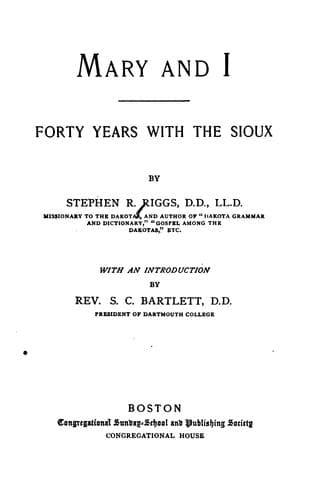
Mary and I: Forty Years with the SiouxRiggs, Stephen Return
History
Mary and I: Forty Years with the Sioux
Riggs, Stephen Return
Dakota Indians -- Missions; Riggs, Stephen Return, 1812-1883
At another point, some few miles below Hope Station, on the same side
of the river, was another Dakota village, where Thomas immediately
commenced holding a preaching service, and has kept up a school. It is
one of his out stations, and called Chantier, from the name of the
creek and bottom. While the opportunities for education and the new
teaching were looked upon favorably, and gladly received by many,
there were not wanting those who were savagely opposed. At different
times, while Henry M. Riggs, who spent several years aiding in the
erection of buildings and other general work, was present with Thomas
at Hope Station, their house and tent were fired upon by Indians, and
residence there seemed hardly safe.
When he had thus started the work, leaving it to be cared for and
carried on by Henry M. Riggs and Edmund Cooley and the native
teachers, Thomas went down to the States to consummate a marriage
engagement with Cornelia Margaret Foster (known as Nina Foster),
daughter of Hon. John B. Foster of Bangor, Me. It was winter, and not
considered advisable for Mrs. Riggs to return with her husband to his
home among the Teetons. She made a visit with her sister, Mrs. C. H.
Howard, at Glencoe, in the vicinity of Chicago, and in the spring
month of May I accompanied her up the Missouri. We had a particularly
long voyage of eleven days, on the _Katie Koontz_, between the Santee
agency and Fort Sully; so long that we picked up Thomas on the way,
coming to meet us in his little skiff.
Thomas and Nina returned to Sully after our mission meeting at the
Yankton agency, and then, in September, went to the meeting of the
board at Minneapolis.
Sully was a far-off station. There were many reasons why a white
woman should not be there alone. Miss Lizzie Bishop's election to go
back with them, together with her beautiful life and early death, have
been detailed in a preceding chapter.
She had fallen out of the working ranks, but others were ready to step
to the front. In the previous spring, Secretary Treat had told me that
there were two young ladies in Iowa who were anxious to engage in
mission work. They preferred to go to the Indians, as they desired to
labor together. It was a David and Jonathan love that existed between
Miss Mary C. Collins and Miss J. Emmaretta Whipple. They were
immediately sent out by the Woman's Board of the Interior to labor at
Bogue Station.
Public-domain text, read in full here on John Shaqi.
Reviews
Reviews
No reviews yet
Be the first to share your thoughts on this work.
Elsewhere in the archive
Join the Discussion
Join the discussion
Sign in to leave a comment or review.
Sign InorCreate an account