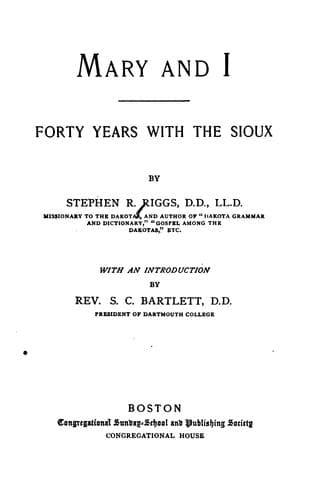
Mary and I: Forty Years with the SiouxRiggs, Stephen Return
History
Mary and I: Forty Years with the Sioux
Riggs, Stephen Return
Dakota Indians -- Missions; Riggs, Stephen Return, 1812-1883
This place, selected in 1873, had for various reasons become in 1874
the home station--thenceforward Hope was only an out-station. Bogue
Station is on Peoria bottom, about fifteen miles below Fort Sully, and
on the same side of the Missouri, called by the Indians
"Tee-tanka-ohe," meaning "The place of a large house," so called from
a house built years ago by an Indian. General Harney selected this
bottom as the place for an agency, or rather, perhaps, where a scheme
of civilization should be tried, and built upon it several log houses,
which became the dwellings of Yellow Hawk and his people. The bottom
has several advantages--considerable cottonwood timber, plenty of
grass for hay, and as good land for cultivation as there is in this
often "dry and thirsty land."[9]
[9] Now named _Oahe_.
The first winter Oyemaza, or James Red Wing, and his wife lived here
with Henry M. Riggs, and taught a school. The second winter Thomas and
Nina, with Miss Bishop, made it their abode. So that it was not quite
a new place to which Miss Collins and Miss Whipple came, and yet new
enough. The mission dwelling is made of logs--one series of logs
joined to another, so as to make four rooms below, one of which has
served as a school-room through the week and a chapel for the Sabbath.
Additions have been made in the rear. The school-room has for a long
time back overflowed on the Sabbath, and the women and children have
been packed into the room adjoining, which is the family room. Hence a
great and growing want of this station has been a chapel and larger
school-room. The name of Bogue was given to the station for Mrs. Mary
S. Bogue, a special friend of Thomas while he was in the seminary, who
has gone to her rest. It was at one time expected that Mr. Bogue would
furnish the means to erect a chapel; but the shrinkage in values and
financial losses made him a broken reed. And so the desired building
has been postponed from year to year. But a small contribution of
fourteen cents, made by little Bertie Howard, was the nucleus around
which larger contributions gathered, chiefly from Nina's native
Bangor. About $400 of special contributions were thus received, and
the prudential committee made a loan, which was afterward made a gift,
of $500 toward it. The building is going up--August, 1877--a neat and
substantial frame, the material of which was brought up from Yankton
by boat. It is forty by twenty feet, and will have a bell-tower in one
corner.
* * * * *
Public-domain text, read in full here on John Shaqi.
Reviews
Reviews
No reviews yet
Be the first to share your thoughts on this work.
Elsewhere in the archive
Join the Discussion
Join the discussion
Sign in to leave a comment or review.
Sign InorCreate an account