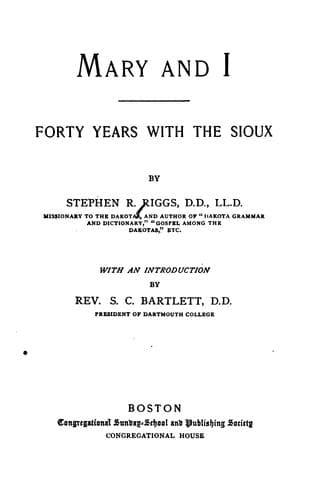
Mary and I: Forty Years with the SiouxRiggs, Stephen Return
History
Mary and I: Forty Years with the Sioux
Riggs, Stephen Return
Dakota Indians -- Missions; Riggs, Stephen Return, 1812-1883
Let me now go back and take up the threads of the narrative which were
dropped two years ago. The two young ladies who desired to work
together in some Indian field found themselves here in Yellow Hawk's
village. They entered into the labors of those who had been here
longer. They grew into the work. The day schools in books and sewing,
together with the night school, employed all hands, during the winter
especially. A number have learned to read and write in their own
language. Besides the school carried on at the home station, the two
out stations have been occupied by native helpers. Edwin Phelps, from
the Sisseton agency, with his mother, Elizabeth Winyan, have been
valuable assistants for two winters past. Also for the winter of
1876-7, David Gray Cloud, one of the native pastors at the head of the
Coteau, did valuable service both in teaching and preaching. He was
sent to Standing Rock by the native missionary society, but, not being
able to get a footing there, he came down here to preach to these
Teetons salvation by Jesus Christ. In the spring, when he was leaving
for Sisseton, they begged him to stay, or at least to promise to come
back again.
The Word, during these years, has not been preached in vain. While in
the main it has been seed-sowing,--only seed-sowing--breaking up the
wild prairie-land of these wild Dakota hearts, and planting a seed
here and there, which grows, producing some good fruit, but in most
cases not yet the best fruit of a pure and holy life,--still, in the
summer of 1876, one young man, the first fruits among the Teetons,
_David Lee_ (Upijate) by name, came out as a disciple of Jesus. This
was the signal for the organization of a church at this station, which
was effected in August. Another native convert, the brother of the
first, was added in the autumn following; and still more a year or so
afterward.
For two winters past, several boys and young men, who have made a good
commencement in education in these schools, have been sent down to
enjoy the advantages of A. L. Riggs' High School at Santee. The Sioux
war of the summer of 1876 produced a great excitement at all the
agencies on the Upper Missouri. The Indians in these villages were
more or less intimately connected with the hostiles. Many of those
accustomed to receive rations here were during the summer out on the
plains. Some of them were in the Custer fight. They say that Sitting
Bull's camp was not large--only about two hundred lodges. The victory
they gained was not, as the whites claimed, owing to the overwhelming
number of the Dakotas, but to the exhausted condition of Custer's men
and horses, and to their adventuring themselves into a gorge where
they could easily be cut off.
Public-domain text, read in full here on John Shaqi.
Reviews
Reviews
No reviews yet
Be the first to share your thoughts on this work.
Elsewhere in the archive
Join the Discussion
Join the discussion
Sign in to leave a comment or review.
Sign InorCreate an account