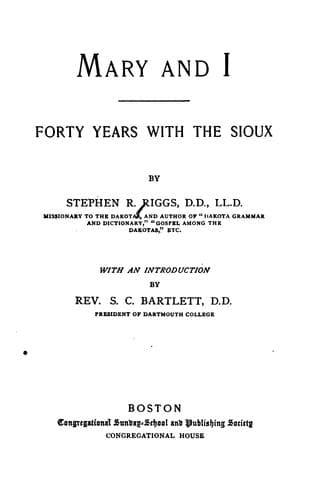
Mary and I: Forty Years with the SiouxRiggs, Stephen Return
History
Mary and I: Forty Years with the Sioux
Riggs, Stephen Return
Dakota Indians -- Missions; Riggs, Stephen Return, 1812-1883
The memories of August 18, 1862, and the days that followed, are
vivid, but must in the main be passed over. I can not forbear,
however, to note what a sorry group we were on that island on the
morning of the 19th. How finally the way appeared, and we filed up the
ravine and started over the prairie as fugitives! How the rain came on
us that afternoon, and what a sorry camping we made in the open
prairie after we had crossed Hawk River! How the little Hakakta girl,
when bed-time came, wanted to go home! How, when the rain had leaked
down through the wagon-bed all night upon them, Mrs. D. Wilson Moore
thought it would be about as good to die as to live under such
conditions! How Hapistinna and Wanskay wore off their toes walking
through the sharp prairie-grass! How we stopped on the open prairie to
kill a cow and bake bread and roast meat, with no pans to do it in!
And how, while the process was going on, we had our picture taken! How
many scares we passed through the night we passed around Fort Ridgely!
How thus we escaped, like a bird from the snare of the fowler,--the
snare was broken, and we escaped. How, when the company came to adjust
their mutual obligations, nobody had any money but D. Wilson Moore!
How those women met us on the top of the hill by Henderson, and were
glad to see us because we had white blood in us! How on the road we
met our old friend Samuel W. Pond, who welcomed our family to his
house at Shakopee!
FAMILY IN ST. ANTHONY.
The memories of the campaign of the next three months may be passed
over, as having little connection with the family. But I remember the
night when, with more than _three hundred condemnations_ in my
carpet-bag, I had a long hunt at midnight for the little hired house
in which the mother and children had re-commenced housekeeping. The
three years in St. Anthony were ones of varied experiences. Wanskay
had gone down to Rockford. Hapan and Hapistinna taught school and kept
house for the mother by turns. The three boys went to school.
The War of the Rebellion was not over, but it was nearing its end, as
we soon knew, when one day the noble boy Thomas brought in a paper for
me to sign, giving my permission for his enlistment. I had heard and
read so much of boys of sixteen going almost at once into the hospital
that I threw the paper in the fire.
WHAT WILT THOU HAVE ME TO DO?
Public-domain text, read in full here on John Shaqi.
Reviews
Reviews
No reviews yet
Be the first to share your thoughts on this work.
Elsewhere in the archive
Join the Discussion
Join the discussion
Sign in to leave a comment or review.
Sign InorCreate an account