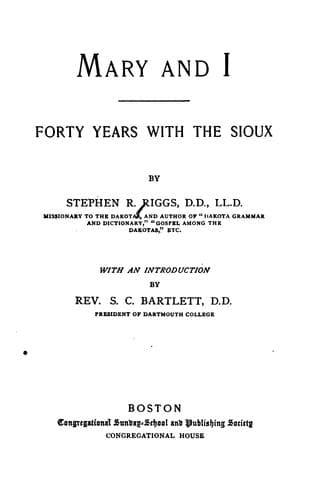
Mary and I: Forty Years with the SiouxRiggs, Stephen Return
History
Mary and I: Forty Years with the Sioux
Riggs, Stephen Return
Dakota Indians -- Missions; Riggs, Stephen Return, 1812-1883
My own special effort in the class-room during the first years was in
teaching a knowledge of figures. The language of counting in Dakota
was limited. The "wancha, nonpa, yamne"--one, two, three, up to
ten,--every child learned, as he bent down his fingers and thumbs
until all were gathered into two bunches, and then let them loose as
geese flying away. Eleven was _ten more one_, and so on. Twenty was
_ten twos_ or _twice ten_, and thirty _ten threes_. With each ten the
fingers were all bent down, and one was kept down to remember the ten.
Thus, when ten tens were reached, the whole of the two hands was bent
down, each finger meaning ten. This was the perfected "bending down."
It was "opawinge"--one hundred. Then, when the hands were both bent
down for hundreds, the climax was supposed to be reached, which could
only be expressed by "again also bending down." When something larger
than this was reached, it was a _great count_--something which they
nor we can comprehend--a million.
On the other side of _one_ the Dakota language is still more
defective. Only one word of any definiteness exists--_hankay_, half.
We can say hankay-hankay--_the half of a half_. But it does not seem
to have been much used. Beyond this there was nothing. A _piece_ is a
word of uncertain quantity, and is not quite suited to introduce among
the certainties of mathematics. Thus, the poverty of the language has
been a great obstacle in teaching arithmetic. And that poorness of
language shows their poverty of thought in the same line. The Dakotas
are not, as a general thing, at all clever in arithmetic.
* * * * *
Before the snows had disappeared or the ducks come back to this
northern land, in the spring of 1840, a baby girl had been added to
the little family in the upper chamber. By the first of June, Mary was
feeling well, and exceedingly anxious to make a trip across the
prairie. She had been cooped up here now nearly three years. There was
nowhere to go. Lac-qui-parle is the "Lake that speaks," but who could
be found around it? And no one had any knowledge of any great Indian
talk held there that might have justified the name. But the romance
was all taken out of the French name by the criticism of Eagle Help,
that the Dakota name, "Mdaeyaydan," did not mean "Lake that talks,"
but "Lake that connects." And so Lac-qui-parle had no historic
interest. It was not a good place to go on a picnic. She had been to
the Indian village frequently, but that was not a place to visit for
pleasure. And on the broad prairie there was no objective point. Where
could she go for a pleasure trip, but to Fort Snelling?
And so we made arrangements for the journey. The little boy "Good
Bird" was left behind, and the baby Isabella had to go along, of
course. We were with Mr. Renville's annual caravan going to the
fur-trader's Mecca.
Public-domain text, read in full here on John Shaqi.
Reviews
Reviews
No reviews yet
Be the first to share your thoughts on this work.
Elsewhere in the archive
Join the Discussion
Join the discussion
Sign in to leave a comment or review.
Sign InorCreate an account