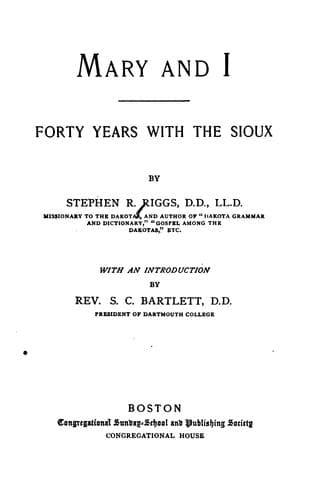
Mary and I: Forty Years with the SiouxRiggs, Stephen Return
History
Mary and I: Forty Years with the Sioux
Riggs, Stephen Return
Dakota Indians -- Missions; Riggs, Stephen Return, 1812-1883
The prairie journey was pleasant and enjoyable, though somewhat
fatiguing. We had our own team and could easily keep in company with
the long line of wooden carts, carrying buffalo robes and other furs.
It was, indeed, rather romantic. But when we reached the Traverse des
Sioux, we were at our wit's end how to proceed further. That was the
terminus of the wagon-road. It was then regarded as absolutely
impossible to take any wheeled vehicle through by land to Fort
Snelling. Several years after this we began to do it, but it was very
difficult. Then it was not to be tried. Mr. Sibley's fur boat, it was
expected, would have been at the Traverse, but it was not. And a large
canoe which was kept there had gotten loose and floated away. Only a
little crazy canoe, carrying two persons, was found to cross the
stream with. Nothing remained but to abandon the journey or to try it
on horseback. And for that not a saddle of any kind could be obtained.
But Mary was a plucky little woman. She did not mean to use the word
"fail" if she could help it. And so we tied our buffalo robe and
blanket on one of the horses, and she mounted upon it, with a rope for
a stirrup. Many a young woman would have been at home there, but Mary
had not grown up on horseback. And so at the end of a dozen miles,
when we came to the river where Le Sueur now is, she was very glad to
learn that the large canoe had been found. In that she and baby
Isabella took passage with Mr. Renville's girls and an Indian woman or
two to steer and paddle. The rest of the company went on by land,
managing to meet the boat at night and camp together. This we did for
the next four nights. It was a hard journey for Mary. The current was
not swift. The canoe was heavy and required hard paddling to make it
move onward. The Dakota young women did not care to work, and their
helm's-woman was not in a condition to do it. On the fourth day out
they ran ashore somewhat hurriedly and put up their tent, where the
woman pilot gave birth to a baby girl. They named it "By-the-way." One
day they came in very hungry to an Indian village. The Dakota young
women were called to a tent to eat sugar. Then Mary thought they might
have called "the white woman" also, but they did not. She did not
consider that they were relatives.
By and by the mouth of the Minnesota was reached, through hardship and
endurance. But then it was to be "a pleasure trip," and this was the
way in which the pleasure came.
Since we had last seen him, S. W. Pond had married Miss Cordelia
Eggleston, a sister of Mrs. J. D. Stevens. The station at Lake Harriet
had been abandoned, the Indians having left Lake Calhoun first. Mr.
Stevens had gone down to Wabashaw's village, and the Pond brothers,
with their families, were occupying what was called the "Stone House,"
within a mile of the Fort. Mary found an old school friend in the
garrison, and so the two weeks spent in this neighborhood were
pleasant and profitable.
Public-domain text, read in full here on John Shaqi.
Reviews
Reviews
No reviews yet
Be the first to share your thoughts on this work.
Elsewhere in the archive
Join the Discussion
Join the discussion
Sign in to leave a comment or review.
Sign InorCreate an account