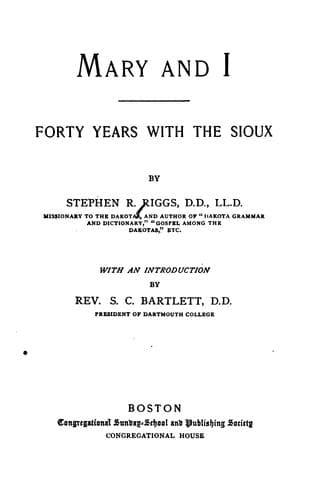
Mary and I: Forty Years with the SiouxRiggs, Stephen Return
History
Mary and I: Forty Years with the Sioux
Riggs, Stephen Return
Dakota Indians -- Missions; Riggs, Stephen Return, 1812-1883
This young man, Anawangmane, had reached that enviable position of
being above Dakota law. He had not only attained to the "first three,"
but he was the chief. And so when he came out on the side of the Lord
and Christianity, there was a propriety in calling him Simon when he
was baptized. He was ordinarily a quiet man--a man of deeds and not of
words. But once in a while he would get roused up, and his eyes would
flash, and his words and gestures were powerful. Simon immediately put
on white man's clothes, and made and planted a field of corn and
potatoes adjoining the mission field. No Dakota brave dared to cut up
his tent or kill his dog or break his gun; but this did not prevent
the boys, and women too, from pointing the finger at him, and saying,
"There goes the man who has made himself a woman." Simon seemed to
care for it no more than the bull-dog does for the barking of a puppy.
He apparently brushed it all aside as if it was only a straw. So far
as any sign from him, one looking on would be tempted to think that he
regarded it as glory. But it did not beget pride. He did indeed become
stronger thereby.
And yet, as time rolled by, it was seen, by the unfolding of the
divine plan, that Simon could not be built up into the best and
noblest character without suffering. Naturally, he was the man who
would grow into self-sufficiency. There were weak points in his
character which he perhaps knew not of. It was several years after
this when Simon visited us at the Traverse, and made our hearts glad
by his presence and help. But alas! he came there to stumble and fall!
"You are a brave man--no man so brave as you are," said the Indians at
the Traverse to him. And some of them were distantly related to him.
While they praised and flattered him, they asked him to drink whiskey
with them. Surely he was man enough for that. How many times he
refused Simon never told. But at last he yielded, and then the very
energy of his character carried him to great excess in drinking
"spirit water."
"LAC-QUI-PARLE, March 27, 1841.
Public-domain text, read in full here on John Shaqi.
Reviews
Reviews
No reviews yet
Be the first to share your thoughts on this work.
Elsewhere in the archive
Join the Discussion
Join the discussion
Sign in to leave a comment or review.
Sign InorCreate an account