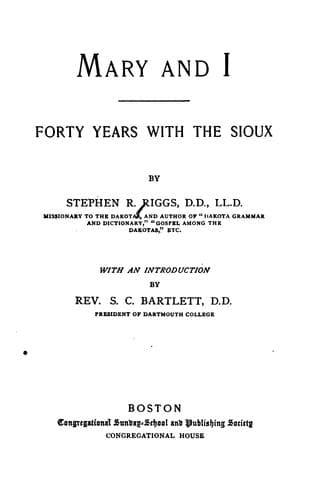
Mary and I: Forty Years with the SiouxRiggs, Stephen Return
History
Mary and I: Forty Years with the Sioux
Riggs, Stephen Return
Dakota Indians -- Missions; Riggs, Stephen Return, 1812-1883
Of the next year--from the spring of 1842--little need be said in this
connection. The preparations were all made. Mary and I took with us
the little boy, now in his fifth year, and the baby, while the little
girl between was left in the care of Miss Fanny Huggins. It was a year
of enjoyment. Mary visited the old home on Hawley hills. The old
grandfather was still there, and the younger members of the family had
grown up. Here, during the summer, the little boy born in Dakota land
gathered strawberries in the meadows of Massachusetts. Our
school-books and hymn-book were printed in Boston, and in the autumn
we came to Ohio. During the winter months the Bible-printing was done
in Cincinnati.
When we were ready to start back, in the spring of 1843, we had
secured as fellow-laborers, at the new station which we were
instructed to form, Robert Hopkins and his young wife Agnes, and Miss
Julia Kephart, all from Ripley, Ohio. The intercourse with so many
sympathizing Christian hearts, which had been much interested in the
Dakota mission from its commencement, was refreshing. We found, too,
that we had both been forgetting our mother tongue somewhat, in the
efforts made to learn Dakota. This must be guarded against in the
future. In our desire to be Dakotas we must not cease to be English.
The bottoms of the Lower Minnesota were putting on their richest
robes of green, and the great wild-rose gardens were coming into full
perfection of beauty, when, in the month of June, our barge, laden
with mission supplies, was making its way up to Traverse des Sioux. At
what was known as "The Little Rapids" was a village of Wahpaton
Dakotas, the old home of the people at Lac-qui-parle. There were
certain reasons why we thought that might be the point for the new
station. We made a halt there of half a day, and called the chief men.
But they were found to be too much under the influence of the Treaty
Indians below to give us any encouragement. In fact, they did not want
missionaries.
We passed by, and landed our boats at the Traverse. The day before
reaching this point, Mrs. Hopkins and Mary had made arrangements to
have some light bread,--they were tired eating the heavy cakes of the
voyage. They succeeded to their satisfaction, and placed the warm
bread away, in a safe place, as they supposed, within the tent, ready
for the morning. But when the breakfast was ready, the bread was not
there. During the night an Indian hand had taken it.
Public-domain text, read in full here on John Shaqi.
Reviews
Reviews
No reviews yet
Be the first to share your thoughts on this work.
Elsewhere in the archive
Join the Discussion
Join the discussion
Sign in to leave a comment or review.
Sign InorCreate an account