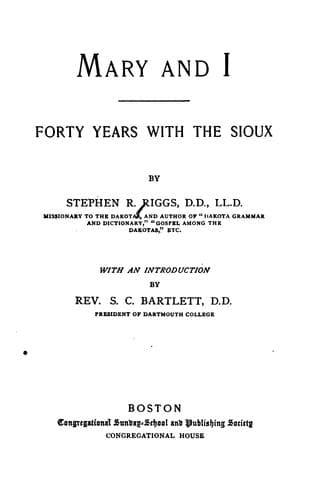
Mary and I: Forty Years with the SiouxRiggs, Stephen Return
History
Mary and I: Forty Years with the Sioux
Riggs, Stephen Return
Dakota Indians -- Missions; Riggs, Stephen Return, 1812-1883
And so it seemed to me the time had come when some better
understanding should be reached in regard to these things. I called
the principal men of the village--Oo-pe-ya-hdaya, Inyangmane, and
Wakanmane, and others--and told them that, as Dr. Williamson was
called away by the Lower Indians, my wife and I had been sent back to
Lac-qui-parle, but we would stay only on certain conditions. We knew
them and they knew us. If we could stay with them as friends, and be
treated as friends, we would stay. We came to teach them and their
children. But if then, or at any time afterward, we learned that the
whole village did not want us to stay, we would go home to our
friends. For the help we gave them, the water we used must be free,
the wood to keep us warm must be free, the grass our cattle ate must
be free, and the field we planted must be free; but when we wanted
their best timber to build houses with, which we should do, I would
pay them liberally for it. This arrangement they said was
satisfactory, and soon afterward we bought from them the timber we
used in erecting two frame houses.
From this time onward we did not suffer so much from cattle-killing,
though it has always been an incident attaching to mission life among
the Indians. For the years that followed we were generally treated as
friends. Sometimes there was a breeze of opposition, some wanted us to
go away, but we always had friends who stood by us. And they were not
always of the same party. The results of mission work began to be seen
in the young men who grew up, many of them desirous of adopting, in
part at least, the habits and the dress of the whites.
There was another reason for a cessation of hostilities on their part;
_viz._, that starvation did not so much stare them in the face. They
had better corn crops than for some years previous. And, besides this,
for two seasons the buffalo range was extended down the Minnesota far
below Lac-qui-parle. For many years they had been far away, west of
Lake Traverse. Now they came back, and for two winters our Indians
revelled in fresh buffalo meat, their children and dogs even growing
fat. And the buffalo robes gave them the means of clothing their
families comfortably.
Sometimes the herds of bison came into the immediate neighborhood of
the village. One morning it was found that a large drove had slept on
the prairie but a little distance back of our mission houses. Mr.
Martin McLeod, the trader, and a few others organized a hunt on
horseback. There was snow on the ground, I hitched our ponies to a
rude sled, and we went to the show. As the hunters came into the herd
and began to shoot them, the excitement increased in our sled--the
ponies could not go fast enough for the lady.
Public-domain text, read in full here on John Shaqi.
Reviews
Reviews
No reviews yet
Be the first to share your thoughts on this work.
Elsewhere in the archive
Join the Discussion
Join the discussion
Sign in to leave a comment or review.
Sign InorCreate an account