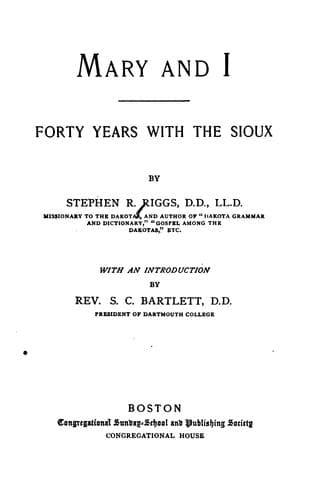
Mary and I: Forty Years with the SiouxRiggs, Stephen Return
History
Mary and I: Forty Years with the Sioux
Riggs, Stephen Return
Dakota Indians -- Missions; Riggs, Stephen Return, 1812-1883
We now addressed ourselves afresh to the work of teaching and
preaching. The day-school filled up. We took some children into our
families. The young men who had learned to read and write when they
were boys, came and wanted to learn something of arithmetic and
geography. In the work of preaching I began to feel more freedom and
joy. There had been times when the Dakota language seemed to be barren
and meaningless. The words for Salvation and Life, and even Death and
Sin, did not mean what they did in English. It was not to me a
heart-language. But this passed away. A Dakota word began to _thrill_
as an English word. Christ came into the language. The Holy Spirit
began to pour sweetness and power into it. Then it was not exhausting,
as it sometimes had been--it became a joy to preach.
MARY'S STORY.
"LAC-QUI-PARLE, May 17, 1847.
"Since Mr. Riggs left home, two weeks to-day, I have had a
double share of wants to supply. I could almost wish he had
locked up the medicine-case and taken the key with him, for I
have not so much confidence in my skill as to suppose the
Indians would have suffered if it had been out of my power to
satisfy their wants. I purposed only giving rhubarb and a few
other simples, but I have been besieged until I have yielded,
and have no relief to hope for until Mr. Riggs returns.
"In addition to the medicines, there has been a great demand
for garden-seeds, to say nothing of the common wants of a
little thread, or soap, or patches for a ragged short-gown, or
a strip of white cloth for the head to enable them to kill
ducks or buffalo, as the case may be. There is scarcely any
view of God's character that gives me so clear an apprehension
of his infinite goodness and power as that of his kind care of
his sinful creatures. He listens to their requests, and giving
doth not impoverish, neither doth withholding enrich him."
"May 26.
"This afternoon twenty-six armed Indian men paraded before the
door and discharged their guns. I was a little startled at
first, but soon learned that they had been in search of
Chippewas that were supposed to be concealed near by, and that
they had returned unsuccessful, and were merely indulging in a
little military exercise."
"Jan. 11, 1848.
"The last Sabbath in December, Mr. Riggs spent at an Indian
encampment about sixteen miles from this place. When he left
home, baby _Samuel_, Mr. and Mrs. Pettijohn's only child, was
ill, but we did not apprehend dangerously so; when he returned
on Monday noon, little Samuel was dead. This has been a severe
affliction to them. Why was this first-born and only son taken,
and our five children spared, is a query that often arises.
Public-domain text, read in full here on John Shaqi.
Reviews
Reviews
No reviews yet
Be the first to share your thoughts on this work.
Elsewhere in the archive
Join the Discussion
Join the discussion
Sign in to leave a comment or review.
Sign InorCreate an account