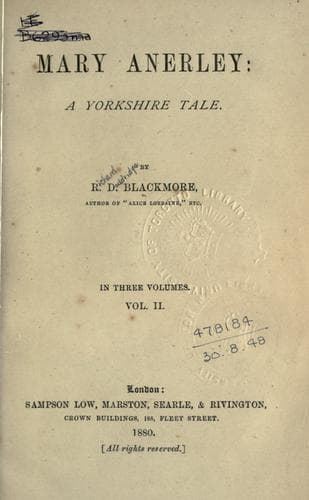
Mary Anerley: A Yorkshire TaleBlackmore, R. D. (Richard Doddridge)
General
Mary Anerley: A Yorkshire Tale
Blackmore, R. D. (Richard Doddridge)
Yorkshire (England) -- Fiction
The mind of Charles Carroway was wide awake to this, and tenderly
anxious about the bad foot in which its owner ended--because of the
importance of the stirrups--and all the sanguine vigor of the heart
(which seemed to like some thumping) conveyed to the seat of reason
little more than a wish to be well out of it. The brave lieutenant
holding place, and sticking to it through a sense of duty, and of the
difficulty of getting off, remembered to have heard, when quite a little
boy, that a man who gazes steadily between his horse's ears can not
possibly tumble off the back. The saying in its wisdom is akin to that
which describes the potency of salt upon a sparrow's tail.
While Carroway gloomily pounded the road, with reflection a dangerous
luxury, things of even deeper interest took their course at the goal of
his endeavors. Mary Anerley, still an exile in the house of the tanner,
by reason of her mother's strict coast-guard, had long been thinking
that more injustice is done in the world than ought to be; and
especially in the matter of free trade she had imbibed lax opinions,
which may not be abhorrent to a tanner's nature, but were most
unbecoming to the daughter of a farmer orthodox upon his own land, and
an officer of King's Fencibles. But how did Mary make this change,
and upon questions of public policy chop sides, as quickly as a clever
journal does? She did it in the way in which all women think, whose
thoughts are of any value, by allowing the heart to go to work, being
the more active organ, and create large scenery, into which the tempted
mind must follow. To anybody whose life has been saved by anybody else,
there should arise not only a fine image of the preserver, but a high
sense of the service done to the universe, which must have gone into
deepest mourning if deprived of No. One. And then, almost of necessity,
succeeds the investment of this benefactor to the world at large with
all the great qualities needed for an exploit so stupendous. He has
done a great deed, he has proved himself to be gallant, generous,
magnanimous; shall I, who exist through his grand nobility, listen
to his very low enemies? Therefore Robin was an angel now, and his
persecutors must be demons.
Public-domain text, read in full here on John Shaqi.
Reviews
Reviews
No reviews yet
Be the first to share your thoughts on this work.
Elsewhere in the archive
Join the Discussion
Join the discussion
Sign in to leave a comment or review.
Sign InorCreate an account