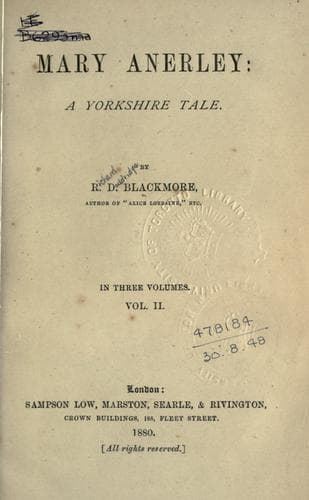
Mary Anerley: A Yorkshire TaleBlackmore, R. D. (Richard Doddridge)
General
Mary Anerley: A Yorkshire Tale
Blackmore, R. D. (Richard Doddridge)
Yorkshire (England) -- Fiction
Captain Lyth had not been slow to enter into his good luck. He knew that
Master Popplewell had a cultivated taste for rare old schnapps, while
the partner of his life, and labor, and repose, possessed a desire
for the finer kinds of lace. Attending to these points, he was always
welcome; and the excellent couple encouraged his affection and liberal
goodwill toward them. But Mary would accept no presents from him, and
behaved for a long time very strangely, and as if she would rather keep
out of his way. Yet he managed to keep on running after her, as much as
she managed to run away; for he had been down now into the hold of his
heart, searching it with a dark lantern, and there he had discovered
“Mary,” “Mary,” not only branded on the hullage of all things, but the
pith and pack of everything; and without any fraud upon charter-party,
the cargo entire was “Mary.”
Who can tell what a young maid feels, when she herself is doubtful?
Somehow she has very large ideas, which only come up when she begins to
think; and too often, after some very little thing, she exclaims that
all is rubbish. The key-note of her heart is high, and a lot of things
fall below harmony, and notably (if she is not a stupe), some of her
own dear love's expressions before she has made up her soul to love him.
This is a hard time for almost any man, who feels his random mind dipped
into with a spirit-gauge and a saccharometer. But in spite of all these
indications, Robin Lyth stuck to himself, which is the right way to get
credit for sticking.
“Johnny, my dear,” said Deborah Popplewell to her valued husband, just
about the time when bold Carroway was getting hot and sore upon the
Filey Road, yet steadily enlarging all the penance of return, “things
ought to be coming to a point, I think. We ought not to let them so be
going on forever. Young people like to be married in the spring; the
birds are singing, and the price of coal goes down. And they ought to be
engaged six months at least. We were married in the spring, my dear, the
Tuesday but one that comes next from Easter-day. There was no lilac
out, but there ought to have been, because it was not sunny. And we have
never repented it, you know.”
“Never as long as I live shall I forget that day,” said Popplewell;
“they sent me home a suit of clothes as were made for kidney-bean
sticks. I did want to look nice at church, and crack, crack, crack they
went, and out came all the lining. Debby, I had good legs in those days,
and could crunch down bark like brewers' grains.”
“And so you could now, my dear, every bit as well. Scarcely any of the
young men have your legs. How thankful we ought to be for them--and
teeth! But everything seems to be different now, and nobody has any
dignity of mind. We sowed broad beans, like a pigeon's foot-tread, out
and in, all the way to church.”
Public-domain text, read in full here on John Shaqi.
Reviews
Reviews
No reviews yet
Be the first to share your thoughts on this work.
Elsewhere in the archive
Join the Discussion
Join the discussion
Sign in to leave a comment or review.
Sign InorCreate an account