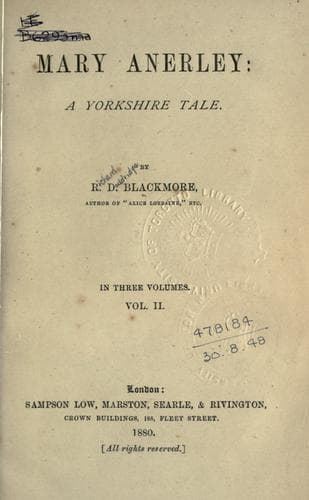
Mary Anerley: A Yorkshire TaleBlackmore, R. D. (Richard Doddridge)
General
Mary Anerley: A Yorkshire Tale
Blackmore, R. D. (Richard Doddridge)
Yorkshire (England) -- Fiction
Meaning all this, Stephen Anerley, however, carried it out in a style at
variance with such reckless vigor. Instead of marching boldly in at his
own door, and throwing himself upon a bench, and waiting to be waited
upon, he left the narrow gravel-walk (which led from the horse gate to
the front door) and craftily fetched a compass through the pleasure beds
and little shrubs, upon the sward, and in the dusk, so that none might
see or hear him. Then, priding himself upon his stealth, as a man with
whom it is rare may do, yet knowing all the time that he was more than
half ashamed of it, he began to peep in at his own windows, as if he
were planning how to rob his own house. This thought struck him, but
instead of smiling, he sighed very sadly; for his object was to learn
whether house and home had been robbed of that which he loved so fondly.
There was no Mary in the kitchen, seeing to his supper; the fire was
bright, and the pot was there, but only shadows round it. No Mary in the
little parlor; only Willie half asleep, with a stupid book upon his lap,
and a wretched candle guttering. Then, as a last hope, he peered into
the dairy, where she often went at fall of night, to see things safe,
and sang to keep the ghosts away. She would not be singing now of
course, because he was so cross with her; but if she were there, it
would be better than the merriest song for him. But no, the place was
dark and cold; tub and pan, and wooden skimmer, and the pails hung up
to drain, all were left to themselves, and the depth of want of life was
over them. “She hathn't been there for an hour,” thought he; “a reek o'
milk, and not my lassie.”
Very few human beings have such fragrance of good-will as milk. The
farmer knew that he had gone too far in speaking coarsely of the cow,
whose children first forego their food for the benefit of ours, and then
become veal to please us. “My little maid is gone,” said the lord of
many cows, and who had robbed some thousand of their dear calves. “I
trow I must make up my mind to see my little maid no more.”
Public-domain text, read in full here on John Shaqi.
Reviews
Reviews
No reviews yet
Be the first to share your thoughts on this work.
Elsewhere in the archive
Join the Discussion
Join the discussion
Sign in to leave a comment or review.
Sign InorCreate an account