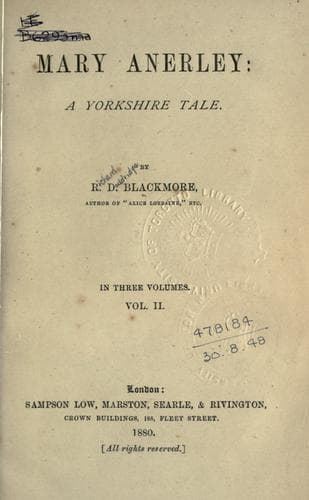
Mary Anerley: A Yorkshire TaleBlackmore, R. D. (Richard Doddridge)
General
Mary Anerley: A Yorkshire Tale
Blackmore, R. D. (Richard Doddridge)
Yorkshire (England) -- Fiction
Without compunction for any mortal cow (though one was bellowing sadly
in the distance, that had lost her calf that day), and without even
dreaming of a grievance there, Master Anerley sat down to think upon a
little bench hard by. His thoughts were not very deep or subtle; yet to
him they were difficult, because they were so new and sad. He had always
hoped to go through life in the happiest way there is of it, with simply
doing common work, and heeding daily business, and letting other people
think the higher class of thought for him. To live as Nature, cultivated
quite enough for her own content, enjoys the round of months and years,
the changes of the earth and sky, and gentle slope of time subsiding to
softer shadows and milder tones. And, most of all, to see his children,
dutiful, good, and loving, able and ready to take his place--when he
should be carried from farm to church--to work the land he loved so
well, and to walk in his ways, and praise him.
But now he thought, like Job in his sorrow, “All these things are
against me.” The air was laden with the scents of autumn, rich and ripe
and soothing--the sweet fulfillment of the year. The mellow odor of
stacked wheat, the stronger perfume of clover, the brisk smell of apples
newly gathered, the distant hint of onions roped, and the luscious waft
of honey, spread and hung upon the evening breeze. “What is the good of
all this,” he muttered, “when my little lassie is gone away, as if she
had no father?”
“Father, I am not gone away. Oh, father, I never will go away, if you
will love me as you did.”
Here Mary stopped; for the short breath of a sob was threatening to
catch her words; and her nature was too like her father's to let him
triumph over her. The sense of wrong was in her heart, as firm and
deep as in his own, and her love of justice quite as strong; only they
differed as to what it was. Therefore Mary would not sob until she was
invited. She stood in the arch of trimmed yew-tree, almost within reach
of his arms; and though it was dark, he knew her face as if the sun was
on it.
“Dearie, sit down here,” he said; “there used to be room for you and me,
without two chairs, when you was my child.”
“Father, I am still your child,” she answered, softly, sitting by him.
“Were you looking for me just now? Say it was me you were looking for.”
“There is such a lot of rogues to look for; they skulk about so, and
they fire the stacks--”
“Now, father, you never could tell a fib,” she answered, sidling closer
up, and preparing for his repentance.
“I say that I was looking for a rogue. If the cap fits--” here he
smiled a little, as much as to say, “I had you there;” and then, without
meaning it, from simple force of habit, he did a thing equal to utter
surrender. He stroked his chin, as he always used to do when going to
kiss Mary, that the bristles might lie down for her.
Public-domain text, read in full here on John Shaqi.
Reviews
Reviews
No reviews yet
Be the first to share your thoughts on this work.
Elsewhere in the archive
Join the Discussion
Join the discussion
Sign in to leave a comment or review.
Sign InorCreate an account