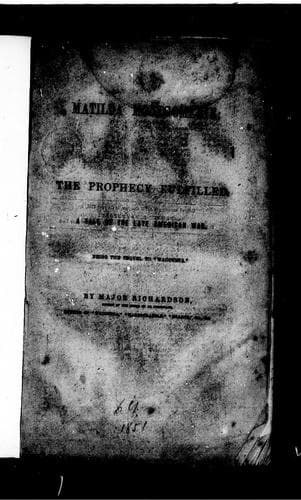
Matilda Montgomerie; Or, The Prophecy Fulfilled — John Shaqi
Matilda Montgomerie; Or, The Prophecy FulfilledRichardson, Major (John)
History
Matilda Montgomerie; Or, The Prophecy Fulfilled
Richardson, Major (John)
United States -- History -- War of 1812 -- Fiction
At his side, hanging on his arm and habited in naval uniform, appeared
one who, from his familiarity of address with the General, not less than
by certain appropriate badges of distinction, might be known as the
commander of the little fleet then lying in the harbor. Shorter in
person than his companion, his frame made up in activity what it wanted
in height, and there was that easy freedom in his movements which so
usually distinguishes the carriage of the sailor, and which now offered
a remarkable contrast to that rigidity we have stated to have attached,
albeit unaffectedly, to the military commander. His eyes, of a much
darker hue, sparkled with a livelier intelligence, and although his
complexion was also highly florid, it was softened down by the general
vivacity of expression that pervaded his frank and smiling countenance.
The features, regular and still youthful, wore a bland and pleasing
character; while neither, in look, nor bearing, nor word could there be
traced any of that haughty reserve usually ascribed to the "lords of the
sea." There needed no other herald to proclaim him for one who had
already seen honorable service, than the mutilated stump of what had
once been an arm: yet in this there was no boastful display, as of one
who deemed he had a right to tread more proudly because he had chanced
to suffer, where all had been equally exposed, in the performance of a
common duty. The empty sleeve, unostentatiously fastened by a loop from
the wrist to a button of the lapel, was suffered to fall at his side,
and by no one was the deficiency less remarked than by himself.
The greeting between Tecumseh and these officers, was such as might be
expected from warriors bound to each other by mutual esteem. Each held
the other in the highest honor, but it was particularly remarked that
while the Indian Chieftain looked up to the General with the respect he
felt to be due to him, his address to his companion, whom he now beheld
for the first time, was warmer, and more energetic; and as he repeatedly
glanced at the armless sleeve, he uttered one of those quick ejaculatory
exclamations, peculiar to his race, and indicating, in this instance,
the fullest extent of approbation. The secret bond of sympathy which
chained his interest to the sailor, might have owed its being to another
cause. In the countenance of the latter there was much of that eagerness
of expression, and in the eye that vivacious fire, that flashed, even in
repose, from his own swarthier and more speaking features; and this
assimilation of character might have been the means of producing that
preference for, and devotedness to, the cause of the naval commander,
that subsequently developed itself in the chieftain. In a word, the
General seemed to claim the admiration and the respect of the
Indian--the Commodore, his admiration and friendship.
Public-domain text, read in full here on John Shaqi.
Reviews
Reviews
No reviews yet
Be the first to share your thoughts on this work.
Join the Discussion
Join the discussion
Sign in to leave a comment or review.
Sign InorCreate an account