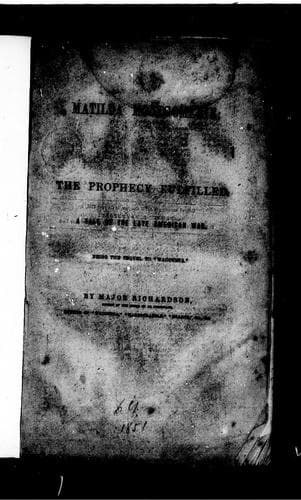
Matilda Montgomerie; Or, The Prophecy FulfilledRichardson, Major (John)
History
Matilda Montgomerie; Or, The Prophecy Fulfilled
Richardson, Major (John)
United States -- History -- War of 1812 -- Fiction
"Traitorous and revengeful scoundrel!" aspirated Henry Grantham, as the
recollection of the manner of his father's death came over his mind. "It
is, at least, some consolation to think his villainy has in part met its
reward. I confess, I exult in the death of young Desborough, less even
because a dangerous enemy has been removed, than because in his fall the
heart of the father will be racked in its only assailable point. I trust
I am not naturally cruel, yet do I hope the image of his slain partner
in infamy may ever after revisit his memory, and remind him of his
crime."
An exclamation of the Indians now drew the attention of the officers to
a boat that came in sight, in the direction in which that of Gerald
Grantham had long since disappeared, and as she drew nearer, a white
flag floating in the stern, became gradually distinguishable.
Expressions of surprise passed among the officers, by whom various
motives were assigned as the cause of the return of the flag of truce,
for that it was their own boat no one doubted, especially as, on
approaching sufficiently near, the blue uniform of the officer who
steered the boat was visible to the naked eye. On a yet nearer approach,
however, it was perceived that the individual in question wore not the
uniform of the British navy, but that of an officer of the American
line, the same precisely, indeed, as that of Major Montgomerie. It was
further remarked that there was no lady in the boat, and that,
independently of the crew, there was besides the officer already named,
merely one individual, dressed in the non-commissioned uniform, who
seemed to serve as his orderly. Full evidence being now had that this
was a flag sent from the American fort, which had, in all probability,
missed Gerald by descending one channel of the river formed by Turkey
Island, while the latter had ascended by the other, the aid-de-camp, De
Courcy, hastened to acquaint General Brock with the circumstance, and to
receive his orders. By the time the American reached the landing-place,
the youth had returned, accompanying a superior officer of the staff.
Both descended the flight of steps leading to the river, when, having
saluted the officer, after a moment or two of conversation, they
proceeded to blindfold him. This precaution having been taken, the
American was then handed over the gun-wale of the boat, and assisted up
the flight of steps by the two British officers on whose arms he leaned.
As they passed through the crowd, on their way to the fort, the ears of
the stranger were assailed by loud yells from the bands of Indians, who,
with looks of intense curiosity and interest, gazed on the passing, and
to them in some degree inexplicable, scene. Startling as was the fierce
cry, the officer pursued his course without moving a muscle of his fine
and manly form, beyond what was necessary to the action in which he was
engaged. It was a position that demanded all his collectedness and
Public-domain text, read in full here on John Shaqi.
Reviews
Reviews
No reviews yet
Be the first to share your thoughts on this work.
Elsewhere in the archive
Join the Discussion
Join the discussion
Sign in to leave a comment or review.
Sign InorCreate an account