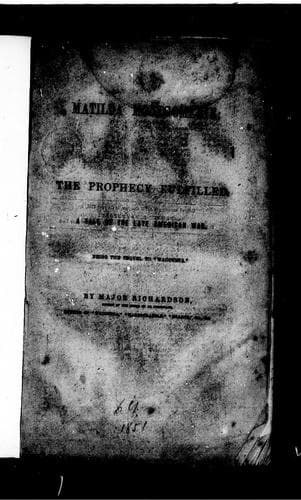
Matilda Montgomerie; Or, The Prophecy FulfilledRichardson, Major (John)
History
Matilda Montgomerie; Or, The Prophecy Fulfilled
Richardson, Major (John)
United States -- History -- War of 1812 -- Fiction
courage, and he seemed as though he had previously made up his mind not
to be deficient in either. Perhaps it was well that he had been
temporarily deprived of sight, for could he have beheld the numerous
tomahawks that were raised towards him in pantomimic representation of
what they would have done had they been permitted, the view would in no
way have assisted his self-possession. The entrance to the fort once
gained by the little party, the clamor began to subside, and the
Indians, by whom they had been followed, returned to the bank of the
river to satisfy their curiosity with a view of those who had been left
in the boat, to which, as a security against all possible outrage, a
sergeant's command had meanwhile been despatched.
It was in the drawing-room of Colonel D'Egville, that the General,
surrounded by his chief officers, awaited the arrival of the flag of
truce. Into this the American Colonel, for such was his rank, after
traversing the area of the fort that lay between, was now ushered, and,
the bandage being removed, his eye encountered several to whom he was
personally known, and with these such salutations as became the occasion
were exchanged.
"The flag you bear, sir," commenced the general, after a few moments of
pause succeeding these greetings, "relates, I presume, to the prisoners
so recently fallen into our hands."
"By no means, General," returned the American, "this is the first
intimation I have had of such fact--my mission is of a wholly different
nature. I am deputed by the officer commanding the forces of the United
States to summon the garrison of Amherstburg, with all its naval
dependencies, to surrender within ten days from this period."
The General smiled. "A similar purpose seems to have actuated us both,"
he observed. "A shorter limit have I prescribed to the officer by whom I
have, this very day, sent a message to General Hull; where, may I ask,
did you pass my flag?"
"I met with none, General, and yet my boat kept as nearly in the middle
of the stream as possible."
"Then must ye have passed each other on the opposite sides of Turkey
Island. The officer in charge was moreover accompanied by two of the
prisoners to whom I have alluded--one a field officer in your own
regiment."
"May I ask who?" interrupted the American quickly, and slightly
coloring.
"Major Montgomerie."
"So I suspected. Was the other of my regiment?"
"The other," said the General, "bears no commission, and is simply a
volunteer in the expedition--one, in short, whose earnest wish to reach
Detroit, was the principal motive for my offering the Major his liberty
on parole."
"And may I ask the name of this individual, so unimportant in rank, and
yet so filled with ardor in the cause, as to be thus anxious to gain the
theatre of war?"
"One probably not unknown to you, Colonel, as the niece of your brother
officer--Miss Montgomerie."
Public-domain text, read in full here on John Shaqi.
Reviews
Reviews
No reviews yet
Be the first to share your thoughts on this work.
Elsewhere in the archive
Join the Discussion
Join the discussion
Sign in to leave a comment or review.
Sign InorCreate an account