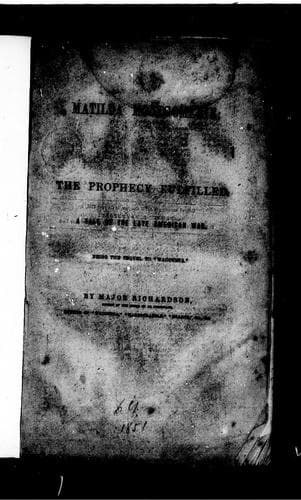
Matilda Montgomerie; Or, The Prophecy FulfilledRichardson, Major (John)
History
Matilda Montgomerie; Or, The Prophecy Fulfilled
Richardson, Major (John)
United States -- History -- War of 1812 -- Fiction
Autumn had passed away, and winter, the stern invigorating winter of
beautiful America had already covered the earth with enduring snows, and
the waters with bridges of seemingly eternal ice, and yet no effort had
been made by the Americans to repossess themselves of the country they
had so recently lost. The several garrisons of Detroit and Malden,
reposing under the laurels they had so easily won, made holiday of their
conquest; and, secure in the distance that separated them from the more
populous districts of the Union, seemed to have taken it for granted
that they had played their final part in the active operations of the
war, and would be suffered to remain in undisturbed possession. But the
storm was already brewing in the far distance which, advancing
progressively like the waves of the coming tempest, was destined first
to shake them in their security, and finally to overwhelm them in its
vortex. With the natural enterprise of their character, the Americans
had no sooner ascertained the fall of Detroit, than means slow but
certain, were taken for the recovery of a post, with which, their
national glory was in no slight decree identified. The country whence
they drew their resources for the occasion, were the new states of Ohio
and Kentucky, and one who had previously travelled through those immense
tracts of forests, where the dwelling of the backwoodsman is met with at
long intervals, would have marvelled at the zeal and promptitude with
which these adventurous people, abandoning their homes, and disregarding
their personal interests, flocked to the several rallying points. Armed
and accoutred at their own expense, with the unerring rifle that
provided them with game, and the faithful hatchet that had brought down
the dark forest into ready subjection to their will, their claim upon
the public was for the mere sustenance they required on service. It is
true that this partial independence of the Government whom they served
rather in the character of volunteers, than of conscripts, was in a
great measure fatal to their discipline; but in the peculiar warfare of
the country, absence of discipline was rather an advantage than a
demerit, since when checked, or thrown into confusion, they looked not
for a remedy in the resumption of order, but in the exercise each of his
own individual exertions, facilitated as he was by his general knowledge
of localities, and his confidence in his own personal resources.
Public-domain text, read in full here on John Shaqi.
Reviews
Reviews
No reviews yet
Be the first to share your thoughts on this work.
Elsewhere in the archive
Join the Discussion
Join the discussion
Sign in to leave a comment or review.
Sign InorCreate an account