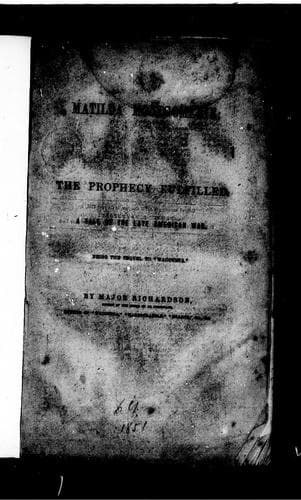
Matilda Montgomerie; Or, The Prophecy FulfilledRichardson, Major (John)
History
Matilda Montgomerie; Or, The Prophecy Fulfilled
Richardson, Major (John)
United States -- History -- War of 1812 -- Fiction
But although new armies were speedily organized--if organized may be
termed those who brought with them into the contest much courage and
devotedness, yet little discipline--the Americans, in this instance,
proceeded with a caution that proved their respect for the British
garrison, strongly supported as it was by a numerous force of Indians.
Within two months after the capitulation of Detroit, a considerable
army, Ohioans and Kentuckians, with some regular infantry, had been
pushed forward as with a view to feel their way; but these having been
checked by the sudden appearance of a detachment from Fort Malden, had
limited their advance to the Miami River, on the banks of which, and on
the ruins of one of the old English forts of Pontiac's days, they had
constructed new fortifications, and otherwise strongly entrenched
themselves. It was a mistake, however, to imagine that the enemy would
be content with establishing himself here. The new fort merely served as
a nucleus for the concentration of such resources of men and warlike
equipment, as were necessary to the subjection, firstly of Detroit, and
afterwards of Fort Malden. Deprived of the means of transport, the
shallow bed of the Miami aiding them but little, it was a matter of no
mean difficulty with the Americans to convey, through several hundred
miles of forest, the heavy guns they required for battering, and as it
was only at intervals this could be effected--the most patient endurance
and unrelaxing perseverance being necessary to the end. From the
inactivity of this force, or rather the confinement of its operations to
objects of defence, the English garrison had calculated on undisturbed
security, at least throughout the winter, if not for a longer period;
but, although it was not until this latter season was far advanced that
the enemy broke up from his entrenchments on the Miami, and pushed
himself forward for the attainment of his final view, the error of
imputing inactivity to him was discovered at a moment when it was least
expected.
It was during a public ball given at Amherstburg, on the 18th of
January, 1813, that the first intelligence was brought of the advance of
a strong American force, whose object it was supposed was to push
rapidly on to Detroit, leaving Amherstburg behind to be disposed of
later. The officer who brought this intelligence was the fat Lieutenant
Raymond, who, commanding an outpost at the distance of some leagues, had
been surprised, and after a resistance very creditable under the
circumstances, driven in by the American advanced guard with a loss of
nearly half his command.
Public-domain text, read in full here on John Shaqi.
Reviews
Reviews
No reviews yet
Be the first to share your thoughts on this work.
Elsewhere in the archive
Join the Discussion
Join the discussion
Sign in to leave a comment or review.
Sign InorCreate an account