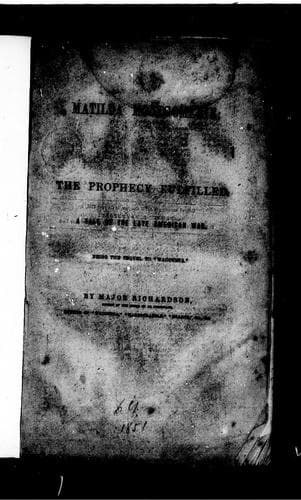
Matilda Montgomerie; Or, The Prophecy FulfilledRichardson, Major (John)
History
Matilda Montgomerie; Or, The Prophecy Fulfilled
Richardson, Major (John)
United States -- History -- War of 1812 -- Fiction
At the moment of his entrance, every eye had been turned upon this
strange apparition, while an almost instinctive sense of the cause of
his presence pervaded every breast. Indeed it was impossible to behold
him arrayed in the bivouac garb in which we have described him,
contrasted as it was with the elegant ball dresses of his brother
officers and not attribute his presence to some extraordinary motive;
and as almost every one in the room was aware of his having been absent
on detachment, his mission had been half divined even before he had
opened his lips to Colonel St. Julian, for whom, on entering, he had
hurriedly inquired.
But when the latter officer was seen soon afterwards to rise from and
leave the card-table, and, after communicating hurriedly with the
several heads of departments, quit altogether the scene of festivity,
there could be no longer a doubt; and, as in all cases of the sort, the
danger was magnified, as it flew from lip to lip, even as the tiny
snow-ball becomes a mountain by the accession it receives in its rolling
course. Suddenly the dance was discontinued, and indeed in time, for the
fingers of the non-combatant musicians, sharing in the general
nervousness, had already given notice, by numerous falsettos, of their
inability to proceed much longer. Bonnets, cloaks, muffs, tippets,
shawls, snow-shoes, and all the paraphernalia of a female winter
equipment peculiar to the country, were brought unceremoniously in, and
thrown _en masse_ upon the deserted benches of the ball-room. Then was
there a scramble among the fair dancers, who, having secured their
respective property, quitted the house; not, however, without a secret
fear, on the part of many, that the first object they should encounter,
on sallying forth, would be a corps of American sharpshooters. To the
confusion within was added the clamor without, arising from swearing
drivers, neighing horses, jingling bells, and jostling sledges. Finally,
the only remaining ladies of the party were the D'Egvilles, whose sledge
had not yet arrived: with these lingered Captain Molineux, Middlemore,
and Henry Grantham, all of whom, having obtained leave of absence for
the occasion, had accompanied them from Detroit. The two former, who had
just terminated one of the old fashioned cotillions, then peculiar to
the Canadas, stood leaning over the chairs of their partners, indulging
in no very charitable comments on the unfortunate Raymond, to whose
inopportune presence at that unseasonable hour they ascribed a host of
most important momentary evils; as, for example, the early breaking up
of the pleasantest ball of the season, the loss of an excellent
anticipated supper that had been prepared for a later hour, and,
although last not least, the necessity it imposed upon them of an
immediate return, that bitter cold night, to Detroit. Near the blazing
wood fire, at their side, stood Henry Grantham, and Captain St. Clair of
the Engineers.
Public-domain text, read in full here on John Shaqi.
Reviews
Reviews
No reviews yet
Be the first to share your thoughts on this work.
Elsewhere in the archive
Join the Discussion
Join the discussion
Sign in to leave a comment or review.
Sign InorCreate an account